
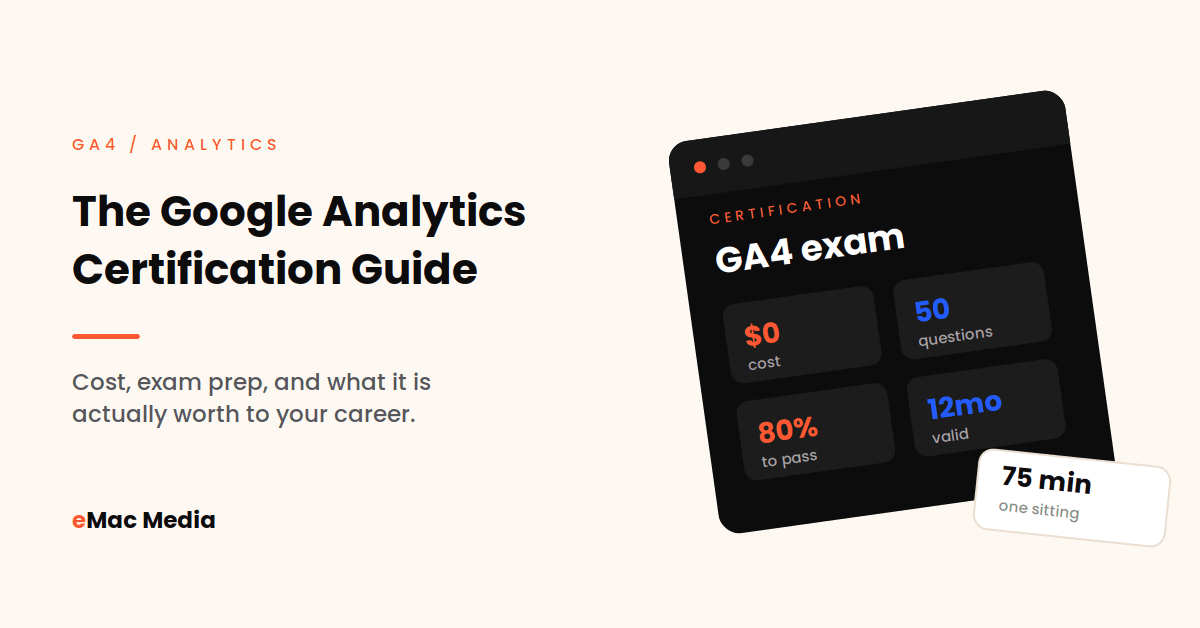

The Google Analytics certification costs nothing. Google runs it on Skillshop, the assessment is 50 questions in 75 minutes, 80 percent passes, and the credential stays current for 12 months. Most of the confusion in the search results traces back to two things. People mix up the free certification with the enterprise price tag on Analytics 360, and many of the questions they ask still use Universal Analytics vocabulary that Google retired in July 2023. This guide separates the credential from the platform, walks through the exam as it is scored today, and gives an honest read on what the certificate does for you after you pass.
How much is the Google Analytics certification?
Nothing. There is no exam fee, no retake fee, no subscription, and no credit card step anywhere in the flow. You sign in to Google Skillshop with a Google account, work through the Analytics learning path, and open the assessment when you are ready. Google issues the certificate the moment you pass.
Paid Google Analytics courses do exist, and none of them issue this credential. Udemy, Coursera and LinkedIn Learning all sell GA4 training, usually between $10 and $200. That material can be useful if you learn better from video, but the certificate at the end carries the name of the platform that sold you the course. Only Skillshop issues the Google credential, and the Skillshop route stays free the whole way through.

| What you are paying for | Cost |
|---|---|
| Skillshop course modules | $0 |
| Certification assessment | $0 |
| Every retake | $0 |
| Recertifying after 12 months | $0 |
| Third-party GA4 courses | $10 to $200, optional, no Google credential attached |
| Google Analytics 4 platform | $0 for standard properties |
| Analytics 360 | Quoted, starting around $50,000 a year |
The exam format, and how it is scored
The assessment runs in your browser on Skillshop. You get 50 questions and 75 minutes, which works out to about 90 seconds per question. Questions mix multiple choice with true or false, and they arrive one topic section at a time rather than as a single long list. Once the timer starts you cannot pause it, so sit down with a clear 90 minutes rather than squeezing it between calls.
You need 80 percent to pass, which means 40 correct answers. Ten wrong is the ceiling. Skillshop scores the assessment instantly and shows you a breakdown by topic area, which matters more than the pass or fail line if you need another attempt. The certificate stays valid for 12 months from the day you pass, and keeping it current means retaking the assessment after it expires.
How many times can you take the Google Analytics test?
As many times as you need. Google sets no cap on attempts. The only constraint is a 24-hour wait between a failed attempt and the next one, which is a change from the old Universal Analytics exam where the wait ran a full seven days.
A failed attempt costs you nothing but a day. That should change how you prepare. Rather than over-studying material you already know, skim the modules, sit the exam, and use the topic breakdown from a near miss as a precise study list for tomorrow. The feedback loop is faster than any practice test you will find.
How long does Google Analytics certification take?
Plan for 4 to 6 hours in total if you already work in GA4. That covers the Skillshop modules, some hands-on time in a property, and the exam itself. Someone who has never opened a GA4 property should budget 8 to 10 hours and spread it across a week, because the reporting interface takes a few sessions to stop feeling foreign.

The study path that works best looks like this:
- Run the Skillshop modules at speed. Four short courses cover account structure, data collection, reporting, and how Analytics connects to other Google products. Watch them once without taking notes.
- Open a real property. Google publishes a demo account with live ecommerce data if you do not have access to one, and our GA4 setup walkthrough covers the property and data stream build if you want your own. Build an exploration, create an audience, and mark an event as a key event so the terms stop being abstract.
- Focus on the vocabulary. Most failed attempts come from terminology rather than concepts. Know the difference between an event parameter and a user property, and know what GA4 calls the things Universal Analytics used to call goals.
- Sit the exam the same week. The material fades fast, and the retake costs nothing.
Certified in the tool, still guessing at the strategy?
Knowing GA4 and knowing which numbers should move are different skills. We build the measurement layer that connects your search traffic to closed revenue.
How much does Google Analytics itself cost?
This is where the search results get muddled, because people searching for the price of the certification and people searching for the price of the platform end up on the same pages. Standard Google Analytics 4 is free, permanently, with no trial window and no credit card at signup. The event and property limits sit high enough that most small and mid-size businesses never touch them.

The paid tier used to be called Google Analytics Premium and is now Analytics 360. Google does not publish a price for it. Contracts are quoted through Google sales or a certified reseller, and reported entry pricing starts at roughly $50,000 a year for about 25 million events a month. Deals scale toward $150,000 a year and beyond at higher volumes. There is no self-serve upgrade button, which tells you who the product is built for.
What 360 buys is scale and guarantees. Unsampled reporting at large query volumes, streaming BigQuery export instead of a daily batch, higher custom dimension limits, roll-up properties across many sites, and a service level agreement with named support. If you are reading this to decide whether your business needs it, you almost certainly do not.
The costs that actually catch small businesses sit elsewhere. A proper implementation takes developer hours. BigQuery storage and query charges add up once you export at volume. And someone has to spend time every month turning the reports into decisions, which is the line item nobody quotes. Those are the numbers worth budgeting for, not the license fee.
What the exam actually tests
The assessment stays close to the GA4 interface. Expect questions on account and property structure, data streams and tagging, the event-based data model, enhanced measurement, audiences, explorations, attribution and channel groupings, and how Analytics links to Google Ads and other advertising platforms. Reporting questions lean on knowing where a given report lives and what its default dimensions are.
Two topic areas generate most of the search volume around this exam, and both reward a few minutes of focused reading.
What are UTM parameters on the Google Analytics exam?
UTM parameters are tags you append to a destination URL so Analytics can attribute the click to a specific campaign. GA4 reads them from the landing page URL and writes them into the traffic source dimensions, which is how an email click shows up as email rather than direct.

Five parameters carry the weight. utm_source names where the click came from. utm_medium names the channel type. utm_campaign ties the link to a campaign. utm_term records a paid keyword, and utm_content distinguishes one creative or link position from another. GA4 also reads utm_id, utm_source_platform, utm_creative_format and utm_marketing_tactic, which are newer additions tied to Google Ads reporting.
The detail exam questions like to test is case sensitivity. Email and email are two different values, and inconsistent tagging across a team splits one campaign into several rows in your reports. Agree a naming convention before anyone builds a link, especially if you run digital PR placements where partners build links on your behalf, or local campaigns that send traffic from several listings at once.
What goals are available in Google Analytics, and what creates Smart Goals?
This question trips people up because the honest answer is that goals no longer exist. Universal Analytics had four goal types that you configured through a setup wizard, plus Smart Goals. GA4 retired the entire concept when Universal Analytics stopped collecting data in July 2023.

In GA4 you mark any event as a key event under Admin, then Data display, then Events. Google renamed these from conversions to key events in March 2024 to stop the metric being confused with Google Ads conversions, which are counted differently. A standard property supports up to 30 key events, and Analytics 360 raises that to 50. An event has to fire at least once before you can mark it, so the tracking comes first and the designation comes second.
Smart Goals were a Universal Analytics feature built for advertisers who had no conversion tracking in place. They needed at least 500 sessions a month, and Google used machine learning to score which sessions looked most engaged, then handed those back to Google Ads as a bidding signal. GA4 has no equivalent, and it does not need one. Predictive audiences cover the modeling side, and Smart Bidding in Google Ads now optimizes against real key events directly. If an exam question or an older article asks what is used to create Smart Goals, the accurate answer today is that nothing does, because the feature retired with the platform that hosted it.
If a study guide still talks about views, sessions as the base unit of measurement, or bounce rate as a primary metric, it was written for Universal Analytics. Check the publication date before you trust any GA4 practice test, because a surprising amount of certification content online has never been updated.
Your analytics are only as good as your tracking
Most measurement problems we inherit are tagging problems. We audit the setup, fix the event taxonomy, and connect every channel to one reporting layer.
How to find your Google Analytics certificate
Your certificate appears in Skillshop the moment you pass. Sign in with the same Google account you used for the assessment, open the profile menu, and go to My Achievements, then the certification tab. The certificate shows the name on your Skillshop profile, the certification name, the issue and expiry dates, and a certificate ID you can quote if an employer asks to verify it.
Skillshop gives you a one-click share to LinkedIn from the same screen, and the badge URL stays the same when you recertify. That means the link on your profile keeps pointing at a live credential rather than breaking every 12 months.
When people cannot find the certificate, the cause is almost always the account. Skillshop ties certifications to a Google account rather than to an email address, so sitting the exam while signed in to a personal account and then searching for it under a work account returns nothing. Sign out, sign back in with the other account, and check again before you assume the record is gone.
What the certification is actually worth
Here is the honest read, from people who hire for these skills. The certification is a reasonable signal and a weak differentiator. It costs a day and it is free, so the return on effort is high. It will not carry an application on its own.
Most job listings ask for GA4 proficiency or experience rather than the certification specifically. Hiring managers who work in analytics daily know how quickly the exam can be passed without real operating skill, and a few of them have been burned by candidates who listed it and then could not explain why a traffic number moved after a migration. The credential works best when it sits next to evidence.
| Where you are | What the certification does |
|---|---|
| Career changer or recent graduate | Real value. It gives you vocabulary, structure, and a line on the resume that passes an applicant tracking filter. |
| Marketer who uses GA4 occasionally | Worth the day. The modules surface features most people never find on their own, like explorations and comparisons. |
| Agency or freelance consultant | Useful as a baseline for client trust, and some directories and partner programs check for it. |
| Working analyst with hands-on GA4 experience | Adds very little. Your implementation history already says more than the badge does. |
Pair the certificate with something a hiring manager can inspect. A short write-up of a tracking plan you designed, a Looker Studio dashboard you built, or a before and after on a measurement fix will do more work than the credential itself. That pattern holds across adjacent skills too, whether you are proving AI search visibility work or link acquisition results. Evidence beats enrollment.
If you want to go deeper after the exam, the rest of our marketing and SEO guides cover the work that happens once the data is flowing.
One timing note. The credential expires after 12 months, so earning it long before you start applying means it reads as expired on your profile exactly when someone checks. If a job search is the reason you are doing this, sit the exam close to when you plan to apply.
Spend the day, pass the exam, put it on your profile, and then go build something with GA4 that you can show someone. The certificate opens a conversation. What you did with the data is what finishes it.
Frequently Asked Questions
References & Sources
- 1.Google Analytics certification learning path · Google Skillshop
- 2.Mark events as key events · Google Analytics Help
- 3.Create or modify key events · Google Analytics Help
- 4.Admin API changelog, key events replacing ConversionEvent · Google Analytics Developers
- 5.Google Analytics certification exam facts · Loves Data
- 6.Google Analytics certification exam structure and retakes · Reliablesoft
- 7.Google Analytics pricing, free versus 360 · Analytify
- 8.Reported Analytics 360 contract pricing · PostHog
- 9.Universal Analytics sunset timeline · Wikipedia


Certified is the starting line, not the finish
We build the measurement layer that ties search, content and paid media to one revenue number. Bring us your GA4 property and we will tell you what it is missing.
Get Your Free Strategy Proposal