
The AI Visibility Scorecard: What Actually Earns a Citation
Most GEO checklists are opinion. This one is built from correlation studies covering 75,000 brands and 129,000 domains, and the ranking it produces reorders a decade of SEO priorities. Unlinked brand mentions across the web correlate at 0.664 with AI Overview visibility, roughly three times as strongly as backlinks at 0.218, and the next two strongest signals are also brand signals rather than site signals. Freshness carries far more weight than it does in classic search: 95% of ChatGPT citations come from content published in the last 10 months, and 76.4% of the most cited pages were updated within 30 days. Two popular tactics do not hold up. Pages with FAQ schema averaged fewer citations than pages without, and a causal study of 1,885 pages found no citation lift from JSON-LD once authority was controlled for. This page covers 15 figures and a five-check scorecard you can run on any page. Updated quarterly.
The numbers at a glance
- 0.664 Brand mention correlation with AI visibility
- 0.218 Backlink correlation, three times weaker
- 95% Of ChatGPT citations are under 10 months old
- 76.4% Of most cited pages updated in the last 30 days
- 41% AI visibility lift from adding statistics to content
Read the text version
The signals
Ahrefs measured correlation with AI Overview visibility across 75,000 brands. Unlinked brand web mentions came out strongest at 0.664, branded anchor text at 0.527 and branded search volume at 0.392. Backlinks reached 0.218, roughly a third of the strength of brand mentions. The three strongest signals all live off your own website, which is the opposite of how most SEO programmes are structured.
Correlation is not causation, and these are observational findings. The direction is consistent across independent studies, which is the strongest evidence currently available in this area.
Freshness
AI citations decay faster than rankings. 95% of ChatGPT citations come from content published in the last 10 months, 76.4% of the most cited pages were updated within the previous 30 days, and AI-cited content runs about 25.7% fresher than what Google surfaces for the same queries. A page that has not been touched in a year is competing against pages touched last month.
What does not work
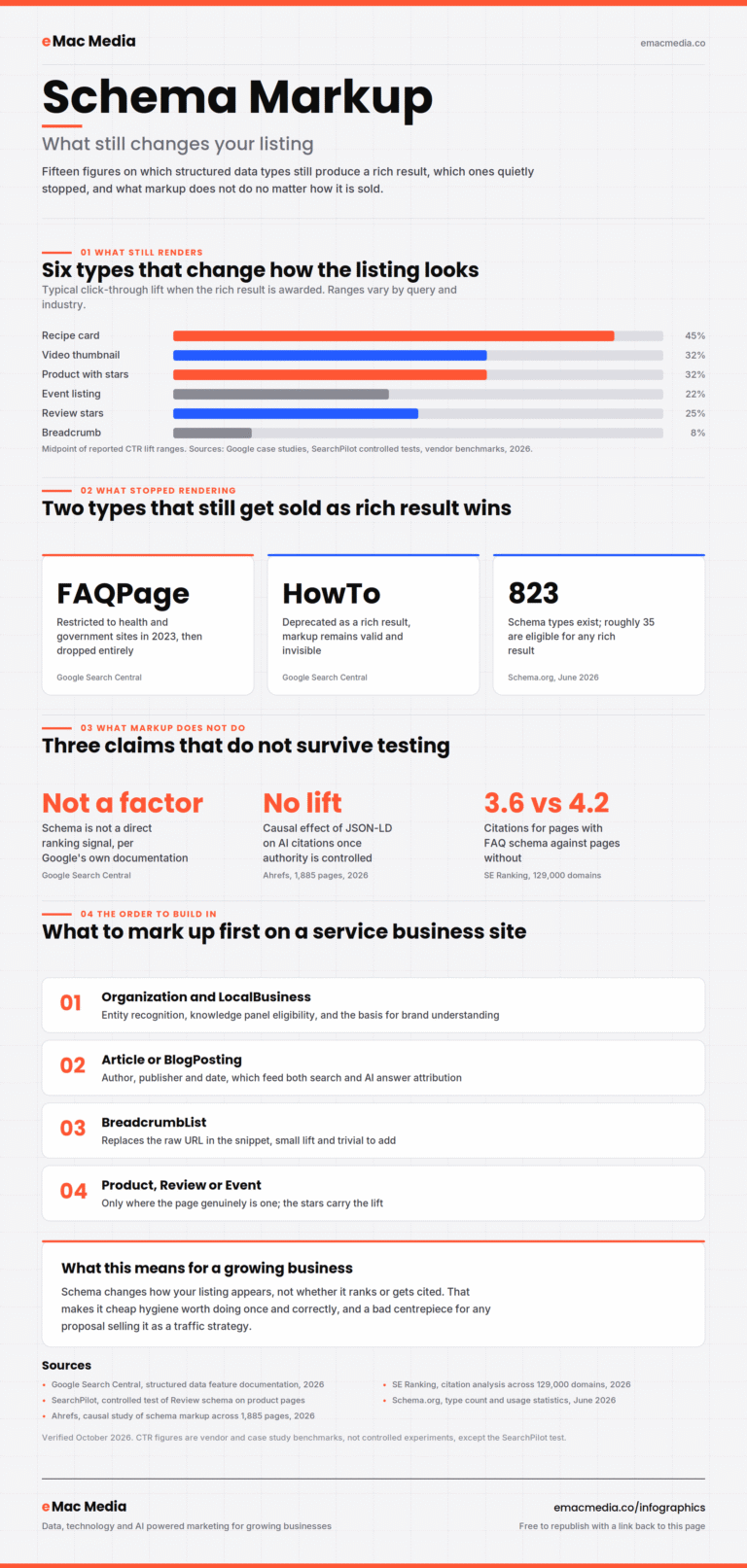
Two widely sold tactics do not survive measurement. In SE Ranking's analysis of 129,000 domains, pages carrying FAQ schema averaged 3.6 citations against 4.2 for pages without it. The researchers note FAQ schema tends to sit on simpler support pages, so the schema is not causing harm, it is just correlated with page types that earn fewer citations. More directly, an Ahrefs causal study across 1,885 pages found no citation lift from JSON-LD schema once domain authority was controlled for. Promotional tone correlates negatively with citation at around -26%.
None of this means schema is useless. It earns rich results and helps machines parse a page. It is hygiene rather than a citation lever, and it should be priced and sold that way.
The scorecard
Five checks, in order. Are you mentioned on pages you do not own, since 85% of brand mentions that count originate on third-party sites. Is the page under 90 days old, since roughly half of AI citations go to content published within 13 weeks. Does it answer the question in the first line rather than after a narrative introduction. Does it carry original data, since adding statistics improved AI visibility 41% in the Princeton and Georgia Tech GEO study. Does it already rank, since pages holding classic rankings share the qualities AI systems look for.
What this means for a growing business
The work that moves AI visibility mostly happens off your website. Earning mentions on pages you do not own, keeping your own pages current, and publishing something nobody else has will beat any amount of markup. That is an uncomfortable finding for agencies selling on-page GEO packages, and it is what the data shows.
Frequently asked questions
What is the strongest signal for getting cited by AI search?
Unlinked brand mentions across third-party websites, correlating at 0.664 with AI Overview visibility across 75,000 brands. That is roughly three times the correlation of backlinks at 0.218.
Does schema markup help with AI citations?
Not causally. An Ahrefs study of 1,885 pages found no citation lift from JSON-LD once domain authority was controlled for, and pages with FAQ schema averaged fewer citations than pages without. Schema remains useful for rich results and machine parsing.
How fresh does content need to be for AI search?
95% of ChatGPT citations come from content published in the last 10 months, and 76.4% of the most cited pages were updated within 30 days. Quarterly updates on pages you want cited is a reasonable floor.
Does original research improve AI visibility?
Yes. Adding statistics to content improved AI visibility by 41% in the peer-reviewed GEO study from Princeton and Georgia Tech, the most effective single technique they tested.
Is GEO different from SEO?
The underlying work overlaps, but the priority order changes. Classic SEO weights links and on-page signals; AI visibility weights off-site brand mentions, freshness and answer-first structure more heavily. Pages that already rank start with an advantage.
Sources
- Ahrefs, AI Overview visibility correlation study of 75,000 brands, 2026
- Ahrefs, causal study of schema markup across 1,885 pages, 2026
- SE Ranking, citation analysis across 129,000 domains, 2026
- AirOps, State of AI Search citation data, 2026
- Aggarwal et al., GEO: Generative Engine Optimization, KDD 2024
Keep reading
 Article
Generative Engine Optimization (GEO): How to Get Cited by AI Search
Home › Learn › Generative Engine Optimization AI & Search Generative Engine Optimization (GEO): How to Get Cited by AI Search AI search engines…
Service
GEO and AI Search Optimization
We score your pages against these five checks, then work on the two that move the number instead of the ones that sell easily.
See how it works
More infographics
View all
See where your site stands
Book a free 30-minute call with our team. We will review your search visibility and show you which fixes to make first.