
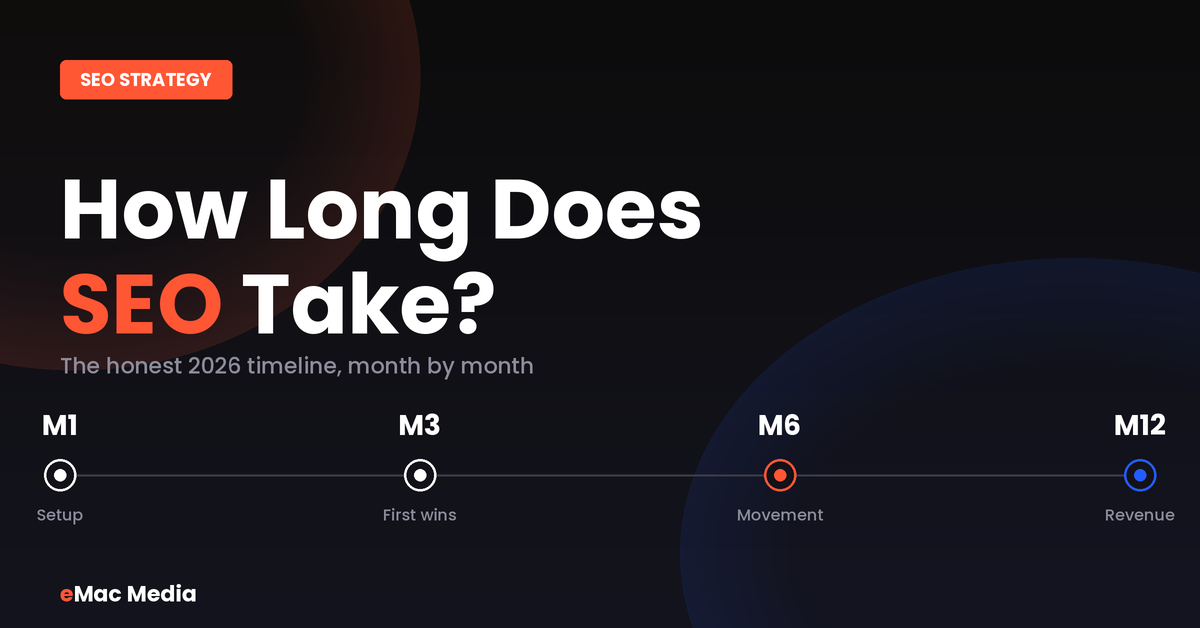




Most SEO campaigns show first movement between month 4 and month 6. Meaningful revenue usually lands between month 9 and month 12. Google's own team says 4 to 12 months is the normal range. Anyone promising page one in 30 days is either targeting keywords nobody searches or setting up a very expensive disappointment.
The Short Answer
Four to six months for the first measurable movement. Nine to twelve months for the kind of results you can build a business around.
That is not us being cautious. Google's own John Mueller has repeatedly told website owners that new content and site changes usually take between four months and a year to reach their full potential in search. Ahrefs analyzed millions of pages and found that only 5.7% of them made it to the top ten within a year of publication, and the average age of a top-ten result is over two years old.
So if you launched a site last month and nothing is ranking yet, that is not a failure. That is the normal shape of the curve. The question worth asking is whether the right things are happening underneath the surface, because a lot of movement happens before rankings actually shift. We will get to that.
What "SEO Results" Actually Means
Half the confusion around SEO timelines comes from vague definitions. "Results" means different things to different people, and the timeline changes drastically depending on which one you are measuring.
Here is how we break it down at eMac Media's SEO team:
- Indexation: Google can find and store your pages. Usually 1 to 14 days after publishing.
- Impressions: Your pages show up in search results for at least some queries. Usually 30 to 90 days.
- Long-tail rankings: You rank for low-competition, specific queries. Usually 60 to 120 days.
- Head-term rankings: You rank on page one for the money keywords. Usually 6 to 12+ months.
- Meaningful revenue: Organic search is driving qualified leads or sales at scale. Usually 9 to 18 months.
When someone asks "how long does SEO take to work," they usually mean the last two. When an agency reports "results after 60 days," they usually mean the first three. That gap is where a lot of frustration lives.
If your agency shows you a lot of graphs going up and to the right at month 2, look closely at what they are measuring. Impressions and long-tail rankings do move fast. Revenue almost never does.
The Realistic SEO Timeline, Month by Month
This is what a well-run SEO campaign looks like from the inside. Assume a mid-sized site in a moderately competitive niche, working with an experienced team, publishing consistently, and building links at a reasonable pace.
| Month | What's Happening | What You'll See |
|---|---|---|
| Month 1 | Technical audit, keyword research, competitive analysis, indexation fixes, initial content briefs | Cleaner Google Search Console data, faster page speed scores, new pages indexed |
| Month 2 | New content publishing begins, on-page optimization on existing pages, internal linking overhaul | Impressions climbing in Search Console, a few long-tail rankings appearing |
| Month 3 | Link acquisition kicks off, content velocity increases, first cluster completion | Ranking movement on low-competition queries, small traffic bump from long-tails |
| Month 4 | Content clusters gain internal authority, first link-building results, freshness signals compound | First meaningful ranking climbs on mid-competition keywords, 20 to 40% traffic lift |
| Month 5-6 | Sustained publishing, digital PR wins, schema and technical refinements | Page-one rankings for target keywords starting to appear, conversion tracking gets interesting |
| Month 7-9 | Authority builds, editorial links accumulate, the site earns trust signals across the topic | Multiple money keywords on page one, organic traffic 2x to 4x starting baseline |
| Month 10-12 | Compounding phase, refresh cycles, expansion into adjacent topics | Meaningful revenue from organic, SEO payback point for most businesses |
| Month 12+ | The moat phase: defending rankings, expanding topical authority, resisting competitor moves | Organic becomes the cheapest channel by CAC, cost per lead drops well below paid |
The middle of the table is where most projects get cancelled. Month 4 and month 5 feel slow, especially compared to paid ads where a bid change moves numbers the same day. Sticking through that stretch is what separates the sites that eventually own their category from the ones that give up and start over every 18 months.
Wondering where you'd land on this timeline?
We look at your site, your competitors, and your keywords, then give you a realistic month-by-month forecast, not a sales pitch.
7 Factors That Speed Up or Slow Down Your Results
The timeline above assumes an average site. Yours is not average. Seven variables push it faster or slower.
1. Site Age and Existing Authority
An established site publishing a new page on a topic it already covers can rank in weeks. A brand-new domain publishing the same page can wait six months for the same result. Google trusts sites that have earned trust, and there is no shortcut around that. This is why acquired domains sometimes move faster than new builds.
2. Keyword Competition
"Best CRM software" and "best CRM software for solo real estate agents in Miami" are the same intent at wildly different difficulty levels. Long-tail queries can rank in 60 to 90 days. Head terms with commercial intent often need a year or more. Smart content strategy starts with the long-tails, builds authority, then goes after the head terms once you have the internal linking and trust signals to compete.
3. Content Quality and Depth
Google has said explicitly that helpful, original content is a ranking system, not a bonus. Thin AI-generated pages that regurgitate what the top ten already say do not rank in 2026. Pages that add something the top ten missed, real data, real experience, a real point of view, tend to move up quickly.
4. Backlink Profile
Links still matter. Ahrefs' analysis of a billion pages shows a clear correlation between referring domains and rankings. Sites that earn quality editorial links move faster than sites that do not. Sites that buy sketchy links move fast and then crash. A steady, natural link acquisition program is one of the biggest levers on how fast your timeline plays out.
5. Technical Health
If Google cannot crawl or index your pages, none of the rest matters. Core Web Vitals, mobile usability, structured data, crawl budget, XML sitemaps, canonical tags. Get these wrong and you can publish for six months with no movement. Get them right and you clear the runway for everything else. Sites with strong web development foundations almost always outperform sites with beautiful designs and broken technical implementations.
6. Publishing Consistency
Two articles a month for a year beats twelve articles in one week. Google's crawl frequency, freshness signals, and topical authority all reward consistent activity. Stop-start publishing sends the wrong signal to both Google and your future compounding traffic.
7. Industry Category
YMYL categories (Your Money, Your Life: health, finance, legal) have stricter quality thresholds and typically take longer. E-commerce with heavy competition takes longer than a niche B2B SaaS with three real competitors. Local service businesses often move fastest of all because the pool is small and the intent is high.
The sites that hit results fastest almost always share three traits: existing authority, ruthless focus on one topic cluster at a time, and the patience to publish for four months before expecting the graphs to move.
Local SEO vs National SEO Timelines
These are not the same game. The playbook overlaps, but the timelines look very different.
Local SEO: 60 to 120 days for meaningful movement
A well-optimized Google Business Profile, consistent NAP citations, and a handful of quality local reviews can move a business into the map pack within three months. There are fewer competitors, and Google leans heavily on proximity, prominence, and relevance. Miami plumbers, Boca Raton dentists, Fort Lauderdale attorneys, these are winnable in a quarter with the right execution. If you serve a specific geography, local SEO is often the fastest ROI channel available.
National SEO: 6 to 12 months for meaningful movement
Ranking for "project management software" or "personal injury lawyer" (without a city qualifier) puts you against sites with a decade of link equity, thousands of pages of content, and full-time SEO teams. First-page rankings for these terms are a year-plus play. Nothing about that is broken. It is just the shape of that market.
E-commerce SEO: 6 to 18 months, longer for competitive categories
Category and product pages have their own timeline complications: technical debt from platform limitations, thin product descriptions, faceted navigation issues, and heavy competition from marketplaces. A well-executed e-commerce SEO program usually starts showing revenue impact around month 6 and hits full stride around month 12 to 18.
What to Expect at 3, 6, and 12 Months
Concrete benchmarks. Screenshot these and compare them to what your agency or team is reporting.
3-Month Milestones
- Technical audit complete, priority fixes deployed
- Keyword strategy documented with target lists per page
- 10 to 20 new or optimized pages live
- Impressions in Google Search Console up 30 to 100%
- First long-tail rankings on page one
- Small but real traffic bump, usually 10 to 25%
- Foundational backlinks acquired
6-Month Milestones
- Multiple content clusters complete and interlinked
- Mid-competition keywords climbing into top 20
- Some target keywords on page one
- Organic traffic 2x to 3x baseline
- Steady link acquisition, referring domains up 20 to 50%
- Conversion tracking showing organic leads or sales
12-Month Milestones
- Money keywords on page one, several in top 5
- Organic traffic 3x to 6x baseline (higher for aggressive builds)
- Organic search driving a meaningful share of pipeline
- Cost per acquisition from organic dropping below paid channels
- Site earning links passively as authority builds
- Clear compounding pattern: month 12 traffic is significantly higher than the sum of months 1 through 6
Not sure where your site stands right now?
Our free SEO ROI Calculator gives you a benchmark on what to expect and how to measure whether your current program is on track.
How to Track Progress Before Rankings Move
Here is what makes the middle months bearable: rankings are a lagging indicator. Long before your keywords hit page one, other signals show whether the work is landing. Watch these instead of refreshing your rank tracker.
When to Question Your SEO Strategy
Not every slow month means the strategy is broken. But some patterns are real red flags worth flagging with your team or agency.
Legitimate reasons for slower results
- You entered a very competitive niche late
- The site had penalty history or technical debt from prior work
- Content velocity has been below what the strategy called for
- Google rolled out a core update mid-campaign
- The budget is too small for the ambition (a $2K/month program cannot outrank enterprise SEO teams)
Red flags that something is actually wrong
- Zero impression growth after 90 days. Even bad SEO usually moves impressions. Zero movement means indexation or targeting is broken.
- Traffic reports without conversion data. If your agency shows traffic charts but cannot tell you what it did for revenue, that is a problem.
- All the links come from the same low-quality directories. This is a future manual action waiting to happen.
- Content is thin, generic, and reads like AI slop. Google's helpful content system will keep it from ranking.
- No technical audit was ever done. This is table stakes. If it did not happen, you are building on a broken foundation.
- Reports use vanity metrics only. "Impressions up 400%" without revenue impact after 12 months is not success.
If any three of those show up in your reports, it is worth getting a second opinion. We do free strategy reviews for exactly this reason. Sometimes the diagnosis is "you're on track, keep going." Sometimes it is "your program has structural problems, here is what to fix." Either way, you get an honest read.
Most SEO campaigns that "did not work" were killed in month 5 or 6, right before the compounding curve would have kicked in. The businesses that get outsized returns from organic search are almost always the ones that stayed patient through the awkward middle months.
Frequently Asked Questions
References & Sources
- 1.How Long Does It Take to Rank in Google? - Ahrefs
- 2.SEO Starter Guide - Google Search Central
- 3.Helpful Content System Guidance - Google Search Central
- 4.Google Ranking Factors Study - Backlinko
- 5.SEO Timeline: How Long Does SEO Take? - Semrush
- 6.How Long Does SEO Take to Show Results - Search Engine Land
- 7.Marketing Statistics - HubSpot
- 8.Improve Your Local Ranking on Google - Google Business Profile Help


Ready to Build a Real SEO Timeline for Your Business?
Skip the guesswork. Our team will map your realistic month-by-month ranking roadmap and show you exactly what it takes to compound organic traffic into revenue.
Get Your Free Strategy Proposal