
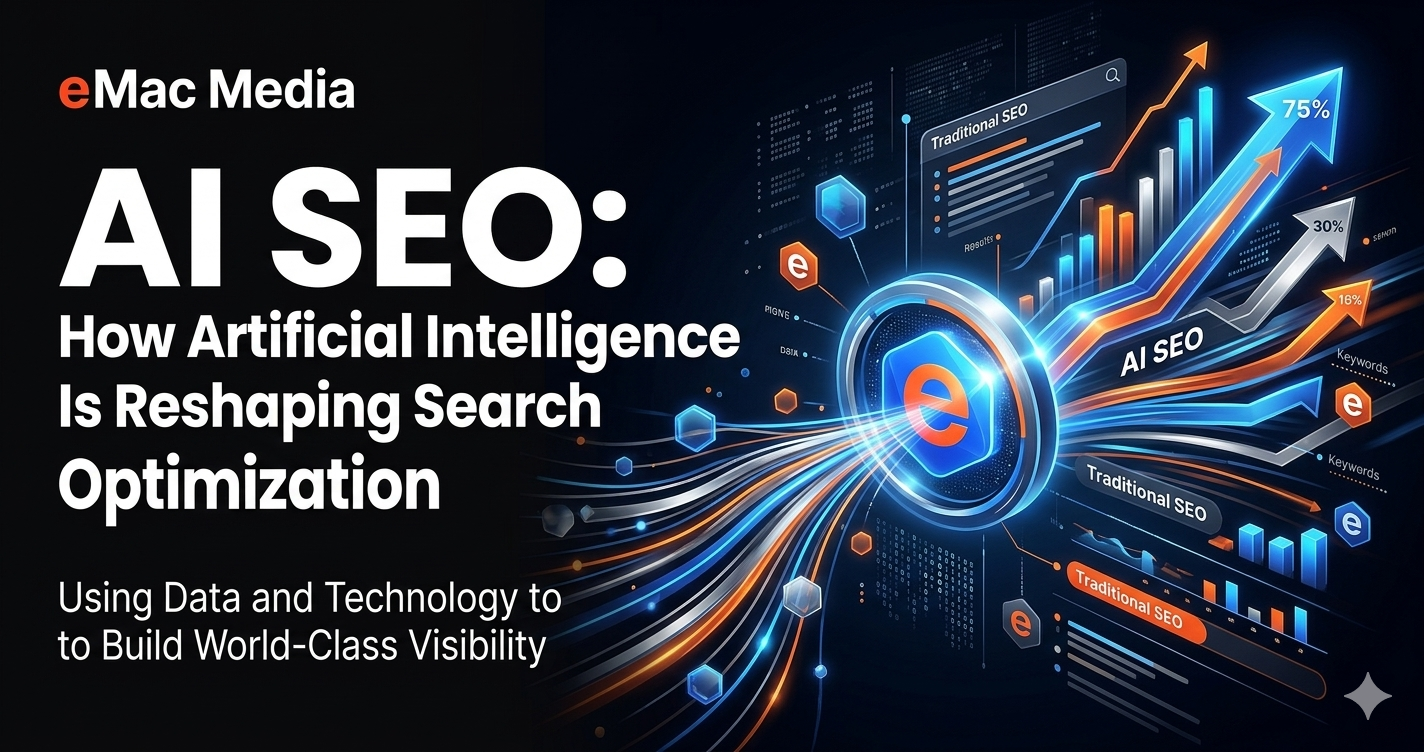




- What AI SEO Actually Means
- How AI Is Rewiring Search Behavior
- Google's AI Evolution: RankBrain to Gemini 3
- AI-Powered Tools Transforming SEO
- E-E-A-T, Entities, and Structured Data
- Risks That Can Sink an AI SEO Strategy
- What Industry Leaders Are Saying
- Nine Strategies to Implement Right Now
- The Statistics Shaping AI SEO
- Frequently Asked Questions
- References & Sources
AI has changed how search works at a fundamental level. Google AI Overviews now reach 2 billion monthly users across 200+ countries. Zero-click searches have climbed past 60%. Organic click-through rates drop 61% on queries where AI answers appear. Meanwhile, ChatGPT crossed 700 million weekly active users and Google AI Mode hit 75 million daily users. The era of ten blue links is over. This article breaks down what happened, what the data actually shows, and what businesses need to do about it right now.
What AI SEO Actually Means
AI SEO is the practice of optimizing content so it gets surfaced, cited, and recommended across AI-powered search platforms. That includes Google AI Overviews, ChatGPT Search, Perplexity, Bing Copilot, Google AI Mode, and Claude. Traditional SEO focused on climbing a ranked list of links through keywords, backlinks, and technical signals. AI SEO targets a different outcome entirely: becoming the source that AI systems quote when they generate direct answers.
The distinction matters because AI search engines don't return a list of pages for users to browse. They synthesize information from multiple sources into a single response, citing only 2 to 7 domains on average per answer. Traditional SEO asked "how do I rank higher?" AI SEO asks "how do I become the answer?"
Related terminology has proliferated. GEO (Generative Engine Optimization), AEO (Answer Engine Optimization), LLMO (Large Language Model Optimization). All fall under the AI SEO umbrella. The foundational GEO research paper from Princeton and IIT Delhi demonstrated that targeted optimization methods can boost visibility by up to 40% in generative engine responses. Aleyda Solis, founder of Orainti, frames it well: the core pillars of SEO remain when optimizing for AI Search. What changes are the criteria based on each platform's characteristics.
Here is the nuance most practitioners miss. Every major AI search product runs on Retrieval-Augmented Generation (RAG) architecture. ChatGPT, Perplexity, Gemini, AI Overviews. They all pull information from traditional search indexes first, then synthesize answers. If your content isn't indexed and ranking in search engines, it cannot enter an LLM's context window. Traditional SEO isn't dead. It is the foundation AI search is built on.
AI SEO and traditional SEO are not competing disciplines. Every AI search platform depends on traditional search indexes for retrieval. If your pages don't rank in Google or Bing, they cannot appear in AI-generated answers.
How AI Is Rewiring Search Behavior
The behavioral shift is hard to overstate. According to SparkToro and Datos, 58.5% of U.S. Google searches ended with zero clicks in 2024. By mid-2025, that figure climbed toward 65%. When AI Overviews appear specifically, zero-click rates spike to around 83%. Google's AI Mode takes it further still, with 93% of sessions ending without a single click to an external site.
Users aren't just clicking less. They are searching differently. AI Mode queries run 3x longer than traditional searches. BrightEdge documented a 7x increase in searches using 8 or more words and a 48% rise in technical vocabulary within queries. A Bloomreach survey found 54% of consumers have shifted toward conversational search habits, favoring natural language over keywords. People ask questions the way they would ask a knowledgeable colleague, and AI platforms are answering accordingly.
The CTR collapse is the most alarming data point for publishers. Seer Interactive's analysis of 3,119 informational queries across 42 organizations found organic CTR dropped from 1.76% to 0.61% when AI Overviews appeared. Paid CTR fared worse, crashing 68% from 19.7% to 6.34%. Pew Research Center's controlled study of 68,000 searches confirmed users clicked results just 8% of the time with AI summaries present versus 15% without.
The traffic consequences are already measurable. Google search traffic to publishers declined globally by a third in the year to November 2025, according to Chartbeat data reported by Reuters Institute. News publishers saw organic traffic fall from 2.3 billion monthly visits to under 1.7 billion. Business Insider lost 55% of organic search traffic. Forbes and HuffPost lost roughly 50%.
But there is a counterintuitive bright spot. BrightEdge found that total search impressions increased by 49% since AI Overviews launched. People are searching more; they are just clicking less. And the traffic that does come through AI channels converts at dramatically higher rates. BrightEdge's cross-industry study found AI search visitors convert at 23x higher rates than traditional organic visitors, with AI-referred traffic valued at 4.4x higher economic value.
Multimodal search adds another dimension. Google Lens now processes 20+ billion visual searches per month. Image-based searches represent 26% of all Google queries as of March 2026. Voice search reached 27% of global search volume, and Google Search Live launched globally in March 2026, enabling real-time voice and camera AI search in 200+ countries.
Google's AI Evolution: RankBrain to Gemini 3
Google has been weaving AI into search for over a decade, but the pace since 2024 has been exponential.
RankBrain (2015) was Google's first deep learning system for search. It translates language into mathematical vectors to understand how words relate to concepts. A search for "consumer at the highest level of a food chain" returns results about apex predators because RankBrain maps the conceptual connection. Originally affecting around 15% of queries and ranked as Google's third most important ranking signal, RankBrain now functions as what experts call the reasoning layer, orchestrating BERT, MUM, and Gemini together.
BERT (2019) introduced bidirectional language understanding. It reads text in both directions to grasp context. The word "for" in "can you get medicine for someone at a pharmacy" completely changes the query's meaning, and BERT captures that. By 2020, BERT powered nearly all English-based search queries. It remains critical for both ranking and retrieval today.
MUM (2021) was announced as 1,000x more powerful than BERT. It understands and generates language across 75 languages while processing text, images, and video simultaneously. An important clarification that often gets missed: Google confirmed MUM is not currently used for general ranking. It is deployed for specific applications like COVID vaccine naming (identifying 800+ name variations across 50+ languages) and certain featured snippets.
The Gemini era is the true inflection point. A custom Gemini model launched for AI Overviews at Google I/O in May 2024. AI Mode arrived in March 2025, powered by Gemini 2.0. By November 2025, Gemini 3 launched, scoring 1501 Elo on the LMArena Leaderboard and 91.9% on GPQA Diamond benchmarks. In January 2026, Gemini 3 became the default model for AI Overviews globally, and Gemini 3 Flash rolled out as the default for AI Mode.
AI Overviews have expanded dramatically. Coverage grew 58% year over year (from 31% to 48% of tracked queries, per BrightEdge) between February 2025 and February 2026. Semrush found AI Overviews in 25.11% of all queries by Q1 2026, analyzing 21.9 million queries. Healthcare leads with 88% of queries triggering AI Overviews. Education follows at 83%, B2B technology at 82%. Shopping remains low at just 3.2%.
Google's January 2025 Quality Rater Guidelines update explicitly instructs raters to assess whether content is AI-generated. That signal flows into the training data for automated quality systems. The message is clear: Google is paying closer attention to how content gets made.
Is Your Brand Visible in AI Search Results?
AI Overviews now appear on 48% of tracked queries. Our AI Visibility audits show exactly where your brand appears (and where it doesn't) across Google AI, ChatGPT, and Perplexity.
AI-Powered Tools Transforming SEO
AI has reshaped every category of SEO tooling, from content creation to link building to competitive intelligence.
Content optimization has seen the most dramatic transformation. SurferSEO now offers dual-mode optimization, scoring content for both Google rankings and AI model preferences simultaneously, with an AI Tracker monitoring brand visibility across ChatGPT, Google AI Overviews, and Perplexity. Clearscope uses Google Cloud, OpenAI, and IBM Watson NLP to grade content from A++ to F based on topical coverage. One Clearscope user reported a 52% increase in organic traffic from optimized content. Webflow grew non-branded SEO traffic by 130% using the platform. Frase now offers dual SEO and GEO scoring, evaluating content for Google alongside ChatGPT, Perplexity, Claude, and Gemini.
AI-driven keyword research has moved beyond volume and difficulty scores. Semrush's Personal Keyword Difficulty score customizes difficulty estimates to your specific domain. Ahrefs' Brand Radar monitors brand visibility across 243 million monthly prompts from real "People Also Ask" data. Keyword Cupid uses unsupervised ML models trained on live Google results to cluster keywords by algorithmic intent rather than text similarity. The shift is from finding keywords to mapping semantic territories and understanding search intent at scale.
Predictive analytics now enables SEO forecasting with 70 to 85% accuracy for six-month projections. Over 60% of leading marketers use predictive analytics to guide SEO strategy (BrightEdge). Tools like seoClarity, BrightEdge Data Cube, and Advanced Web Ranking model competitive scenarios and predict traffic impact from ranking changes.
Technical SEO auditing benefits from AI in issue detection and prioritization. Screaming Frog now integrates with ChatGPT and Gemini via API, auto-generating missing image alt text during crawls. Sitebulb's AI-driven "Hints" system explains issues in plain language with prioritization by impact. Lumar crawls up to 450 URLs per second with built-in Lighthouse speed reporting for every URL. The AI layer transforms "200K duplicate pages detected" into three root causes, three fixes, and the affected templates.
AI-powered link building handles 80 to 90% of heavy lifting in prospecting and outreach. Ahrefs found AI link prospecting is 64% faster than manual research with no quality drop. Campaigns combining AI prospecting with manual relationship building achieved 37% higher acceptance rates (Backlinko). Tools like Respona, Pitchbox, and BacklinkGPT automate everything from prospect identification to personalized email generation.
Programmatic SEO has become both more powerful and more dangerous. Zapier maintains 70,000+ programmatic pages driving 6.3 million monthly visits. But the risks are real: roughly 60% of programmatic SEO projects fail, and G2 lost 80% of its SEO traffic since 2023 due to programmatic content penalties. Google's scaled content abuse policy specifically targets using AI to generate many pages without adding value.
E-E-A-T, Entities, and Structured Data
The convergence of traditional SEO and AI optimization demands real shifts in strategy. But it does not mean abandoning SEO fundamentals.
E-E-A-T has become the dividing line between content that thrives and content that dies. Google's Danny Sullivan confirmed it directly: they use a variety of signals as a proxy to tell if content matches E-E-A-T as humans would assess it, and in that regard, yes, it functions as a ranking factor. An Ahrefs study of 600,000 pages found 86.5% of top-ranking pages use AI assistance. AI content isn't penalized on its own. What matters is whether that content demonstrates genuine experience, expertise, authoritativeness, and trustworthiness. Content with 100% human-written copy earns a 78% citation rate in relevant AI queries. Raw, unedited AI content earns just 14%.
Structured data is a confirmed advantage in AI search. In April 2025, Google's Search team confirmed structured data gives an advantage in AI search results. Microsoft's Fabrice Canel independently confirmed schema markup helps Bing's LLMs understand content for Copilot. Analysis shows 65% of pages cited by AI Mode and 71% of pages cited by ChatGPT include structured data. Sites deploying deeply nested, error-free advanced schema see 20 to 40% traffic lifts. The priority stack: Organization schema (with sameAs linking to Wikipedia, Wikidata, LinkedIn), Person schema for author authority, Article/Product schemas, FAQPage schema for AI-extractable Q&A pairs, and Review/AggregateRating schemas for trust signals.
Entity optimization is replacing keyword targeting. Branded web mentions have the strongest correlation (0.664) with AI Overview appearances. That is far higher than backlinks (0.218). Building a Content Knowledge Graph connecting brands, products, people, and topics with their relationships helps AI systems construct deep semantic understanding. Wikidata is the higher-priority starting point over Wikipedia: no notability requirement, immediately machine-readable, and entities are queried directly by Google Knowledge Graph, Apple Siri, Amazon Alexa, and Microsoft Copilot.
The GEO opportunity is substantial. The GEO market grew to $886 million in 2024 and is projected to reach $7.3 billion by 2031, a 34% CAGR. Companies seeing positive GEO ROI report 300 to 500% returns within 6 to 12 months. But Lily Ray issued a critical warning in March 2026: many GEO tactics risk undermining the SEO that AI search depends on. She called out practitioners who are simply repackaging core SEO approaches under a different name. The takeaway: GEO and SEO are convergent strategies, not competing ones.
Structured data is no longer optional. 65-71% of pages cited by AI platforms include schema markup, and Google confirmed it gives an advantage in AI search results. Start with Organization and Person schema, then add FAQPage for content you want AI to cite directly.
Risks That Can Sink an AI SEO Strategy
The integration of AI into SEO has created new hazard zones that demand careful navigation.
Google's enforcement against low-quality AI content has intensified. The March 2024 core update aimed to reduce unoriginal content by 40% and introduced the "scaled content abuse" policy. By June 2025, Google began issuing manual actions explicitly for scaled content abuse. Entire sites were deindexed for mass-produced AI content. An SE Ranking experiment found 20 AI-only websites lost all rankings in February 2025. Google's position is precise: using automation, including AI, to generate content with the primary purpose of manipulating ranking violates their spam policies. They don't target AI content as a category. They target low-value content that exists to game rankings, regardless of how it was produced.
Hallucination remains a systemic risk. Companies spent $12.8 billion on hallucination reduction between 2023 and 2025. In legal AI applications, hallucination rates ranged from 69% to 88%. For SEO content, the rate is approximately one factual error per 650 raw AI words, reduced to below 0.2 errors with manual fact-checking. The reputational risk extends beyond your own content. AI search engines may generate confidently wrong statements about your brand, products, or services that you cannot control.
Over-reliance on AI produces diminishing returns. Some 10% of web strategists saw ranking drops when publishing raw AI drafts without human refinement. And 29% of marketers saw no ROI from faster AI content output. The core problem is commodity content: widely available, undifferentiated information that AI can generate cheaply. Danny Sullivan warned explicitly that more of this kind of commodity content is not going to be your strength. Google's automated systems increasingly detect AI's signature patterns: structural uniformity, lack of lived experience, and absence of verifiable references.
Copyright concerns add legal exposure. The U.S. Copyright Office requires a "human author" for copyright protection of creative works, leaving pure AI outputs in a legal gray zone. Multiple regulations now require AI disclosure: the EU AI Act, Singapore's AI Governance Framework, and various U.S. state laws. The safest approach treats AI outputs as drafts requiring human review, editing, and substantive augmentation.
What Industry Leaders Are Saying
Sundar Pichai has framed this as a generational technology shift. At the NYT DealBook Summit in December 2024, he said search itself will continue to change profoundly. Internally, he told Google employees that 2025 would be critical and the company needed to move faster. The stakes, he said, are high.
Liz Reid, VP and Head of Google Search, declared at Google I/O that Google will do the Googling for you. She confirmed AI Mode is the future of Google Search, and announced AI Overviews reaching over 1.5 billion monthly users.
Rand Fishkin cuts through the hype with data. His SparkToro research found Google processed 14 billion searches per day in 2024, which is 373x more than estimated daily search-like prompts on ChatGPT. Google's search volume actually grew 21% in 2024 compared to 2023. His advice: stop thinking of SEO as your only tool and Google rankings your only target. The world is bigger, and your tactics transfer to other channels.
Lily Ray has become perhaps the most incisive voice on AI search's impact. She warned that if Google makes AI Mode the default in its current form, it will have a devastating impact on the internet. She urged practitioners to invest in sustainable strategies that search engines cannot take away: personal brands, thought leadership, and original research.
Gartner VP Analyst Alan Antin made the boldest prediction in February 2024: traditional search engine volume would drop 25% by 2026 due to AI chatbots and virtual agents. As of early 2026, the prediction appears directionally correct but overly aggressive on timing. Gartner's subsequent prediction that organic traffic could decrease by 50% or more by 2028 suggests they view this as a multi-year compression, not a single cliff.
Ready to Build Your AI Search Strategy?
With 60%+ of searches ending in zero clicks, traditional tactics alone won't cut it. Our DRIVE Framework combines SEO, AI visibility, and entity optimization into a unified growth strategy.
Nine Strategies to Implement Right Now
The organizations winning in AI search are executing on a specific playbook. Here is what the data says works.
1. Lead with direct answers, then go deep
AI systems extract passages, not pages. Structure content with a direct answer in the first 40 to 60 words of each section, followed by supporting detail. Maintain fact density with specific statistics every 150 to 200 words. The Q&A format is optimal for AI extraction, and FAQPage schema makes it machine-readable.
2. Build your brand's entity graph aggressively
Branded web mentions correlate most strongly (0.664) with AI Overview appearances. Invest in Wikidata entries, digital PR, expert commentary in industry publications, and consistent entity signals across Wikipedia, LinkedIn, Crunchbase, and G2. BrightEdge found 34% of AI citations come from PR and media coverage and roughly 10% from social platforms, especially LinkedIn and Reddit.
3. Implement comprehensive structured data
The evidence is clear: 65 to 71% of pages cited by AI search platforms include structured data. Prioritize Organization schema with sameAs properties linking to authoritative profiles, Person schema for authors, and FAQPage schema for content you want AI to cite directly.
4. Optimize for chunk-level retrieval
AI search operates at the passage level, not the page level. Each section of your content should function as a standalone, self-contained answer that makes sense without surrounding context. Aleyda Solis calls this "chunk-level relevance," the atomic unit of AI search visibility.
5. Invest in original research and first-person experience
This is the moat AI cannot cheaply replicate. Content featuring proprietary data, original surveys, expert interviews, and first-person experience earns dramatically higher citation rates. AI systems need trustworthy sources, and original research signals trustworthiness in ways that rewritten commodity content cannot.
6. Monitor AI visibility as a core KPI
Track how AI platforms describe and cite your brand using tools like Semrush AI Visibility Toolkit, Ahrefs Brand Radar, or BrightEdge AI Catalyst. The key metrics: citation share, share of voice in AI responses, brand sentiment in AI outputs, and entity recognition accuracy. Over 35 AI search monitoring tools launched in 2024 and 2025 alone.
7. Don't abandon traditional SEO
As Britney Muller stated, every single URL you see in an LLM output comes from a search engine API. Ahrefs found 76.1% of URLs cited in AI Overviews also rank in Google's top 10. Traditional ranking remains the primary pathway to AI visibility. Brands cited in AI Overviews earn 35% more organic clicks and 91% more paid clicks compared to those not cited.
8. Diversify across AI platforms
BrightEdge found that ChatGPT and AI Overviews recommend the same brands 76% of the time, but each platform has distinct preferences. ChatGPT favors encyclopedic content. Perplexity rewards recency and citations. Google AI Overviews prefer content that already ranks organically. Test your top 30 to 50 queries monthly across ChatGPT, Perplexity, Google AI Overviews, and Gemini. About 45% of marketers are now pursuing multi-platform AI search strategies.
9. Treat AI as a workflow accelerator, not a content factory
The highest performing approach: use AI for research, structure, ideation, and drafts, then layer in human expertise, unique perspective, and rigorous fact-checking. Companies using this method publish 47% more content monthly while maintaining quality that satisfies both E-E-A-T requirements and AI citation standards. AI-optimized pages perform 32% better in SERP rankings than non-AI-assisted pages, but only when human expertise guides the process.
The Statistics Shaping AI SEO
The following data points capture the current state of AI search, drawn from the most authoritative research available.
| Statistic | Source | Year |
|---|---|---|
| 60% of Google searches end without a click | SparkToro / Bain | 2025 |
| Organic CTR drops 61% when AI Overviews appear (1.76% to 0.61%) | Seer Interactive | 2025 |
| AI Overviews reach 2 billion monthly users across 200+ countries | 2025 | |
| Google AI Mode has 75 million daily active users | 2026 | |
| ChatGPT has 700+ million weekly active users | OpenAI / Semrush | 2025 |
| AI Overview coverage grew 58% year-over-year (31% to 48%) | BrightEdge | 2026 |
| 25.11% of searches trigger AI Overviews (21.9M queries) | Conductor | 2026 |
| AI search visitors convert at 23x higher rates | BrightEdge | 2025 |
| AI-referred traffic valued at 4.4x higher economic value | Semrush / Ahrefs | 2025 |
| Google Lens processes 20+ billion visual searches per month | 2025 | |
| 94% of marketers plan to use AI in content creation in 2026 | HubSpot | 2026 |
| 86% of SEO pros have integrated AI into workflows | seoClarity | 2025 |
| 74.2% of new web pages contain AI-generated content | Ahrefs (900K study) | 2025 |
| GEO market: $886M (2024) projected to $7.3B by 2031 | Incremys | 2026 |
| Gartner predicts search volume will drop 25% by 2026 | Gartner | 2024 |
| Google search traffic to publishers declined 33% globally | Chartbeat / Reuters | 2026 |
| 65% of pages cited by AI Mode include structured data | Industry analysis | 2025 |
| 76.1% of AI Overview citations from pages in Google's top 10 | Ahrefs | 2025 |
| Branded mentions have 0.664 correlation with AI Overview appearances | Position Digital | 2026 |
| Total search impressions increased 49% since AI Overviews launched | BrightEdge | 2025 |
| AI marketing market: $47.32B (2025), projected $107.5B by 2028 | Multiple firms | 2025 |
The data tells a nuanced story. Search isn't dying. Google volume grew 21% in 2024, and total impressions are up 49%. But the value chain is being redistributed. Fewer clicks reach publishers, yet the clicks that arrive convert at dramatically higher rates. The winners will be organizations that earn AI citations through genuine expertise, original data, and entity authority.
The most important insight from this data: AI SEO and traditional SEO are deeply interconnected disciplines. Every AI search platform depends on traditional search indexes for retrieval. Building entity authority, implementing structured data, and creating genuinely authoritative content serves both simultaneously. Organizations that treat these as a unified strategy will capture disproportionate visibility in both channels.
The window for establishing AI search authority is open now. Competition in AI search is currently 70% lower than in traditional SEO. The GEO market is growing at 34% CAGR. AI-referred traffic converts at 23x traditional organic rates. That window will not stay this wide for long.
Frequently Asked Questions
AI SEO is the practice of optimizing content so it gets discovered, cited, and recommended by AI-powered search platforms like Google AI Overviews, ChatGPT, Perplexity, and Bing Copilot. It builds on traditional SEO fundamentals but adds strategies for becoming the source that AI systems reference when generating direct answers.
Google does not penalize AI content as a category. It targets low-value content created primarily to manipulate rankings, regardless of how it was produced. An Ahrefs study of 600,000 pages found 86.5% of top-ranking pages use some form of AI assistance. The key is whether content demonstrates genuine expertise, experience, and value to readers.
Organic CTR drops approximately 61% when AI Overviews appear on a search result, falling from 1.76% to 0.61% according to Seer Interactive's analysis of over 3,000 informational queries. However, BrightEdge data shows that brands cited within AI Overviews earn 35% more organic clicks and 91% more paid clicks compared to those not cited.
GEO (Generative Engine Optimization) focuses specifically on getting content cited by AI-generated answers, while traditional SEO targets rankings in standard search results. In practice, the two are deeply connected because AI search platforms use traditional search indexes for content retrieval. The most effective approach treats them as a unified strategy rather than competing disciplines.
Start with strong traditional SEO fundamentals since AI platforms pull from search indexes. Then add structured data (Organization, Person, FAQPage schema), build entity authority through digital PR and consistent brand signals across platforms, create content with direct answers in the first 40-60 words of each section, and monitor AI visibility using tools like Semrush AI Visibility Toolkit or Ahrefs Brand Radar.
References & Sources
- 1.SEOmator — 30+ AI SEO Statistics for 2026
- 2.Semrush — 26 AI SEO Statistics for 2026
- 3.SeoProfy — 52 AI SEO Statistics in 2026
- 4.Google Blog — How AI Powers Great Search Results
- 5.Search Engine Journal — SEO Pulse: AI Mode Hits 75M Users
- 6.BrightEdge — One Year Into Google AI Overviews
- 7.Search Engine Land — Google AI Overviews Drive 61% Drop in Organic CTR
- 8.Gartner — Search Engine Volume Will Drop 25% by 2026
- 9.Search Engine Land — Rand Fishkin on the SEO Opportunity Pie Shrinking
- 10.Lily Ray (Substack) — Your GEO Strategy Might Be Destroying Your SEO
- 11.Google Blog — Gemini 3 Flash Rolling Out Globally in Google Search
- 12.Search Engine Journal — Google AI Overviews Surges Across 9 Industries
- 13.Search Engine Land — AI Search Is Booming, but SEO Is Still Not Dead
- 14.BrightEdge — AI Search Visits Surging in 2025
- 15.Search Engine Land — Why Entity Authority Is the Foundation of AI Search Visibility
- 16.ALM Corp — Google AI Overviews Now Running on Gemini 3
- 17.Search Engine Land — Google Quality Raters Now Assess AI-Generated Content
- 18.Dataslayer — AI Overviews and CTR Impact Analysis
- 19.arXiv — GEO: Generative Engine Optimization (Princeton/IIT Delhi)
- 20.Digital Applied — 60% Zero-Click Searches: The 2026 SEO Crisis Strategy
- 21.iPullRank — The Vicious Cycle of SEO: How We Got Here (Lily Ray at SEO Week 2025)
- 22.Search Engine Journal — Structured Data's Role in AI and AI Search Visibility


AI Search Is Here. Is Your Business Ready?
With $50M+ in client revenue generated and 291+ campaigns delivered, eMac Media builds AI search strategies that drive measurable growth.
Get Your Free Strategy Proposal