





Digital marketing ROI comes down to one question: for every dollar you put in, how many dollars come back? The formula is straightforward. Where companies trip is on the inputs, deciding what counts as a cost, what counts as revenue, and which channel deserves credit for a sale that touched five of them. This guide walks through the formula agencies use, the metrics that actually predict revenue, how to measure each channel, and the attribution decisions that quietly change the number your CFO sees.
What ROI Means in Marketing
Return on investment measures how much profit a campaign produces relative to its cost. In digital marketing, that means comparing the revenue traced back to your marketing against everything you spent to generate it: ad budget, agency fees, software, and the hours your team put in.
The trouble starts with a definition problem. Three terms get used as if they mean the same thing, and they do not.
| Term | What It Measures | Best For |
|---|---|---|
| ROI | Profit against total marketing cost (ads, salaries, tools, creative) | Judging whether the whole program makes money |
| ROAS | Revenue against advertising spend only | Judging whether a specific ad or campaign is pulling its weight |
| ROMI | Incremental revenue attributable to marketing, minus marketing cost | Isolating what marketing added beyond baseline demand |
Most conversations about "ROI" are really about ROAS, because ad platforms report it automatically and it looks impressive. A 6:1 ROAS sounds great until you fold in the agency retainer, the creative production, and the software stack, at which point the true ROI might be 2:1. Serious measurement starts by agreeing on which number you are actually talking about. If you want a partner who reports the real figure rather than the flattering one, that discipline belongs to revenue marketing and CRO, where every dollar is tracked to a conversion.
The ROI Formula (And an Example)
Here is the calculation every marketer should have memorized:
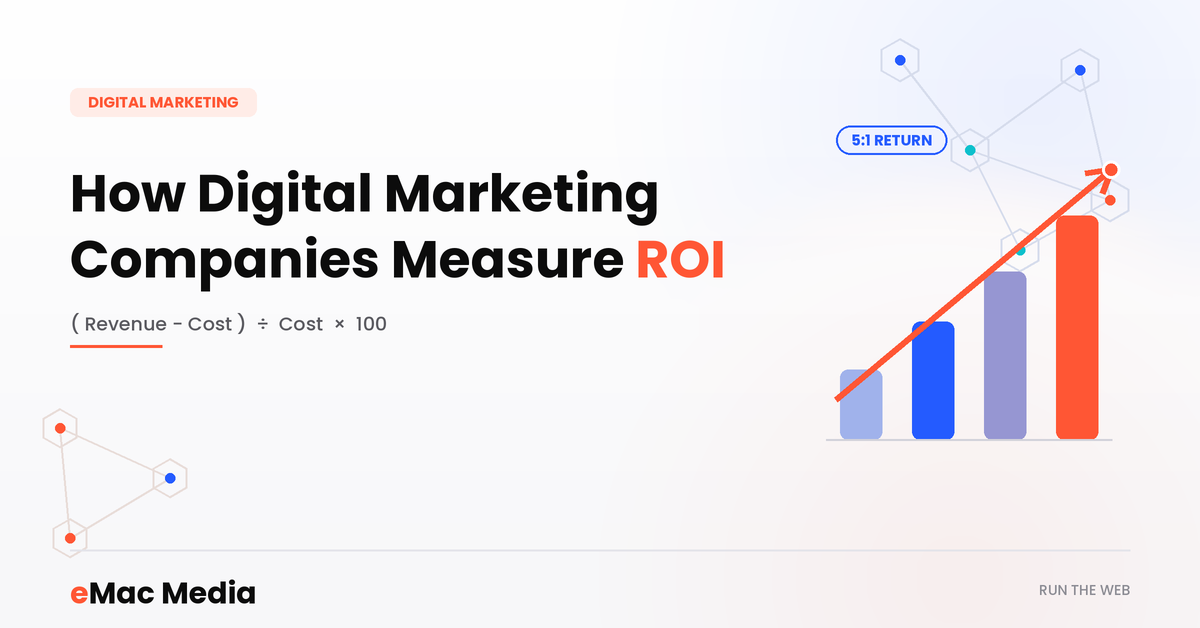
Marketing ROI = (Revenue − Marketing Cost) ÷ Marketing Cost × 100
Say a campaign spent $10,000 across ads, tools, and management, and it produced $40,000 in tracked revenue. The math runs ($40,000 − $10,000) ÷ $10,000 × 100, which lands at 300% ROI, or a 4:1 return. For every dollar in, four came back, three of them profit.
Nielsen has reported that media alone drives roughly 10 to 35 percent of a brand's total sales, which tells you two things. Marketing moves real revenue, and a big chunk of sales would happen anyway. That second point is why smart teams eventually graduate to incrementality, measuring the lift a campaign caused rather than the sales that merely passed through it. More on that when we reach attribution.
Metrics That Predict Revenue
ROI is a lagging number. It tells you what already happened. Agencies watch a handful of leading metrics that predict where ROI is heading, so they can fix a campaign before the monthly report goes red.
Customer Acquisition Cost (CAC)
CAC is your total sales and marketing spend divided by the number of new customers it produced. If you spent $20,000 and won 40 customers, your CAC is $500. Rising CAC is usually the first sign a channel is saturating or the targeting has drifted.
Customer Lifetime Value (LTV)
LTV is the total profit a customer generates over the whole relationship, not just the first sale. This is the metric most businesses underweight, and it is the reason a "bad" CAC can still be a great investment. A $500 CAC looks reckless against a $200 first order and brilliant against a customer worth $4,000 over three years. Businesses with strong retention, especially ecommerce brands with repeat purchase behavior, can afford to spend far more to acquire a customer than the first transaction suggests.
The LTV:CAC Ratio
This single ratio explains more about a marketing program's health than almost any other. A widely used benchmark is 3:1, meaning each customer is worth three times what you paid to acquire them. Below 1:1 you are losing money on every sale. Above 5:1 you may actually be underspending and leaving growth on the table.
Conversion Rate and ROAS
Conversion rate, the share of visitors who take the action you want, is the lever that quietly multiplies every other number. Double it and you double revenue without adding a dollar of spend, which is why UX and design work often produces the fastest ROI gains of anything on this list. ROAS, meanwhile, keeps your paid channels honest in near real time.
Not sure what your marketing is actually returning?
We build measurement into every engagement, so you see revenue by channel, not vanity metrics. Let's map your numbers together.
Measuring ROI Channel by Channel
Every channel reports success differently, and each one hides its ROI in a different place. Here is how agencies pin down the return for the channels most businesses run.
| Channel | Primary ROI Signal | Watch Out For |
|---|---|---|
| Paid Search & Social | ROAS, cost per acquisition, conversion value in the ad platform | Platform-reported conversions inflate credit; verify against your CRM |
| SEO | Organic revenue, non-brand traffic value, assisted conversions | Slow to mature; judging it in 30 days understates the return |
| Content Marketing | Influenced pipeline, organic leads, time-on-page to conversion | Rarely last-click; needs multi-touch attribution to look fair |
| Revenue per send, list-driven repeat purchases | Easy to over-credit when it is the final nudge, not the source | |
| Local / GBP | Calls, direction requests, store visits, booked appointments | Phone and offline conversions vanish without call tracking |
Paid channels give you the cleanest, fastest read. Spend, clicks, and conversions sit in one dashboard, which is why digital advertising is where most companies start measuring. The catch is that ad platforms grade their own homework and tend to over-report. Always reconcile platform conversions against what actually landed in your CRM and automation system.
SEO is the channel most often accused of poor ROI, usually because it is measured on the wrong timeline. Rankings compound. A page that earns a top spot keeps pulling traffic for years with no additional spend, which is why SEO services tend to post the strongest long-run return once the payback period passes. Authority matters here too: consistent link building is often the difference between a page that ranks and one that stalls on page two.
Content marketing reportedly costs about 62 percent less than traditional marketing while generating roughly three times as many leads, according to Demand Metric. The measurement challenge is that content rarely gets the last click. Someone reads three articles, subscribes, and converts on a branded search weeks later. Without multi-touch attribution, that content marketing work looks like it did nothing, when it did the heavy lifting up front.
Email remains the return leader by most accounts. Litmus has reported an average of $36 back for every $1 spent. Local businesses have their own blind spot: a huge share of conversions happen by phone or in person, so local SEO ROI collapses to near zero on paper unless call tracking and offline conversion imports are wired in.
The Attribution Problem
Attribution is the single biggest reason two honest people can look at the same campaign and reach opposite conclusions. A customer clicks a Google ad, forgets about you, reads a blog post two weeks later, gets a retargeting nudge, and finally converts after a branded search. Five touchpoints, one sale. Who gets the credit?
Your answer changes the ROI of every channel. Here are the models agencies use, from simplest to most sophisticated:
- Last-click: all credit to the final touch. Simple, and it systematically robs top-of-funnel channels like SEO and content.
- First-click: all credit to the first touch. Flatters awareness channels, ignores what closed the deal.
- Linear: credit split evenly across every touch. Fairer, but pretends all touches matter equally.
- Time-decay: more credit to touches closer to the sale. A reasonable middle ground for longer sales cycles.
- Data-driven: algorithmic credit based on which touches actually move conversions. The current standard when you have the volume to support it.
For companies where marketing spend is large enough to justify it, marketing mix modeling (MMM) and incrementality testing go a step further, measuring the true lift a channel caused rather than the sales that happened to pass through it. Google and others have leaned hard into these methods as third-party cookies fade and click-based tracking gets less reliable. The practical takeaway: pick an attribution model deliberately, document it, and never compare ROI across two periods that used different models.
Want to see your ROI before you commit a budget?
Plug your numbers into our free SEO ROI Calculator and get a projected return in under a minute. No email wall.
Building a Tracking Stack That Doesn't Lie
None of the math above works if the data feeding it is broken. A measurement stack has a few non-negotiable parts, and most ROI disputes trace back to one of them being missing.
Analytics and Event Tracking
GA4 is the baseline for most businesses, with conversion events defined for every action that matters: form submissions, calls, purchases, bookings. The events have to be set up correctly, which sounds obvious and is the step most often botched. Server-side tracking increasingly matters too, since browser-based tags miss a growing share of conversions as privacy controls tighten. A properly instrumented site is part of solid website development, not an afterthought bolted on later.
CRM and Revenue Data
Clicks are not revenue. To measure real ROI you have to connect marketing touchpoints to closed deals, which means the CRM and the ad platforms have to talk to each other. This is where CRM and marketing automation earns its keep, feeding offline conversions and deal values back into the platforms so they optimize toward money rather than form fills.
Call and Offline Tracking
For service businesses, home services, healthcare, legal, phone calls are the conversion. Dynamic number insertion ties each call back to the campaign, keyword, or page that drove it. Skip this and you will systematically undervalue every channel that generates calls, which is most of them for local businesses.
UTMs and Consistent Tagging
Consistent UTM parameters on every link keep source and medium clean so campaigns do not smear into an unhelpful "direct / none" bucket. Boring, unglamorous, and the foundation everything else sits on. As AI-driven search reshapes how people find businesses, keeping this hygiene tight is part of staying visible across AI and search platforms where traditional tracking gets murkier.
Mistakes That Distort ROI
Even with good tools, a few habits quietly wreck the numbers. Watch for these:
- Chasing vanity metrics. Impressions, likes, and follower counts feel like progress. They do not pay salaries. If a metric cannot be tied to revenue or pipeline, it belongs in a footnote, not a headline.
- Ignoring lifetime value. Judging campaigns on first-purchase revenue alone kills acquisition efforts that would be wildly profitable once repeat business is counted.
- Measuring on too short a window. Long sales cycles and slow-building channels like SEO get written off before they mature. Match the measurement window to the buying cycle.
- Trusting platform-reported ROAS. Every ad platform claims credit for conversions others also touched. Add them up across platforms and the "revenue" often exceeds your actual sales. Reconcile against the CRM.
- Forgetting the cost of the marketing itself. ROAS ignores labor, tools, and creative. A campaign with a 5:1 ROAS can still lose money once the full cost of running it is included.
How a Good Agency Reports ROI
An agency worth paying does not hand you a screenshot of ad platform ROAS and call it a report. Strong ROI reporting is transparent about method and honest about what marketing can and cannot claim. Every month you should see revenue attributed by channel, the attribution model stated plainly, CAC and LTV trends, and a clear line from spend to pipeline to closed revenue.
The goal is a number you can defend to a finance team, not one engineered to make the agency look good. SEO stays the foundation of that return because it compounds and lowers acquisition costs over time, while paid, content, email, and automation layer on top to accelerate and capture demand. When those channels are measured with one consistent method and connected to real revenue data, ROI stops being a debate and becomes a decision-making tool.
Frequently Asked Questions
References & Sources
- 1The ROI of media and the role of measurement — Nielsen
- 2Email Marketing ROI: Metrics and Tips — Litmus
- 3Content Marketing Cost and Lead Generation Data — Demand Metric
- 4Data and Measurement Strategies — Think with Google
- 5Marketing Statistics & Trends — HubSpot
- 6Marketing Analytics and Measurement — Gartner
- 7Attribution and Attribution Models in GA4 — Google Analytics Help


Ready to see what your marketing is really worth?
We tie every dollar of spend to real revenue, so you know exactly which channels earn their keep. Let's build a measurement plan around your goals.
Get Your Free Strategy Proposal