
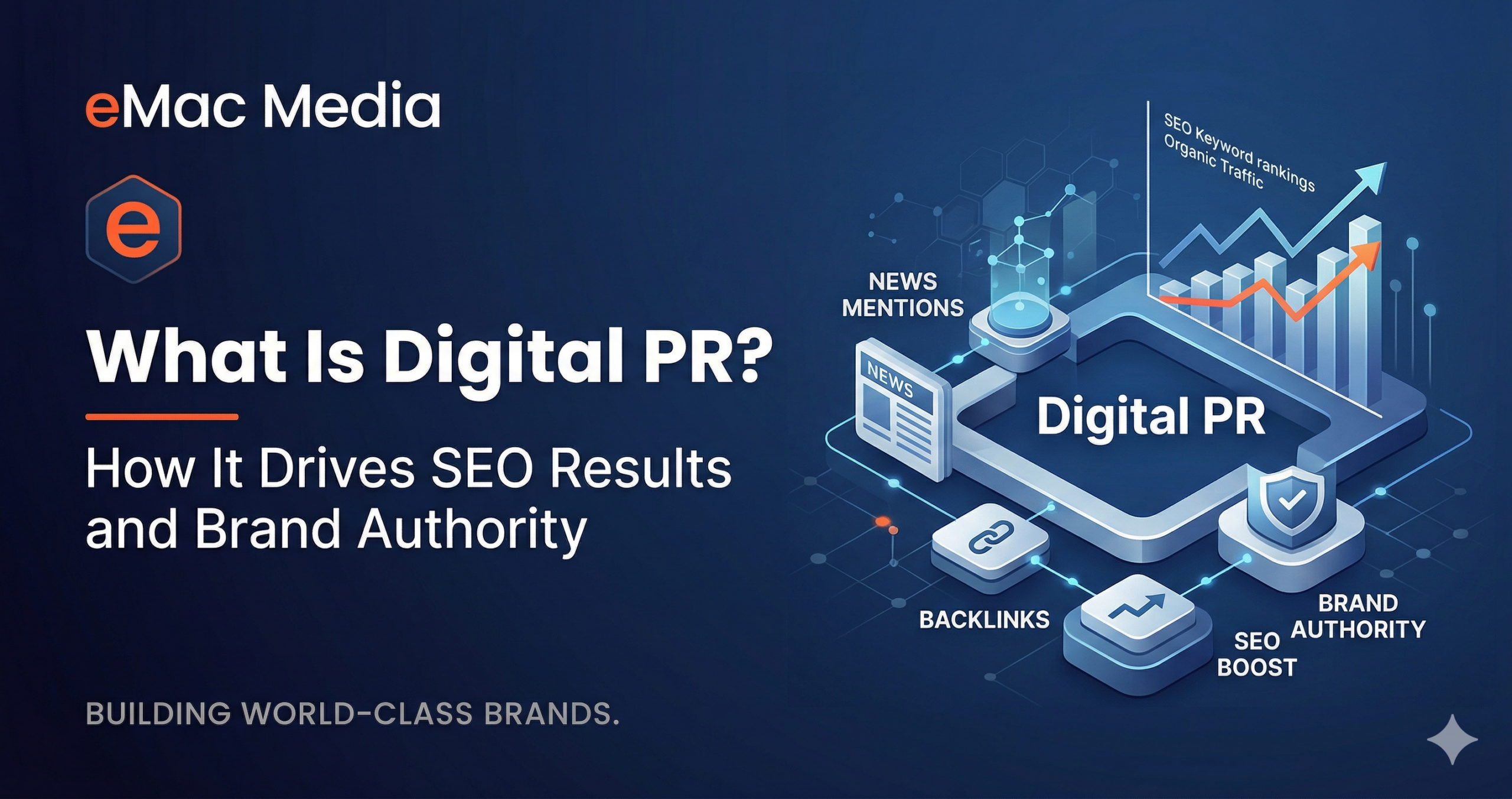





Digital PR has moved well past its early days as a nice-to-have marketing channel. It now sits at the center of how brands get discovered, both through traditional search engines and AI-powered platforms like ChatGPT, Perplexity, and Google's AI Overviews. This guide breaks down what digital PR is, how it directly improves SEO performance, the tactics that actually work, what the data says about effectiveness, and why AI search is making earned media more valuable than it has ever been.
What digital PR actually is (and isn't)
Digital PR is the practice of earning online media coverage, editorial backlinks, and brand mentions through strategies like journalist outreach, data-driven content campaigns, expert commentary, and thought leadership. It sits at the intersection of traditional public relations, SEO, and content marketing.
That definition sounds clean. In practice, it means creating something genuinely newsworthy, getting it in front of journalists who cover your space, and earning coverage that sends real signals to search engines. The "something newsworthy" part is where most brands trip up. A press release about your new product features is not digital PR. An original data study that reveals something surprising about your industry is.
Google itself has given digital PR a rare public endorsement. John Mueller, Google's Search Advocate, has stated that digital PR is "just as critical as tech SEO, probably more so in many cases." That distinction matters because it separates digital PR from the kind of link schemes Google penalizes. When a legitimate publication links to your content because a journalist found it valuable, that is exactly the kind of signal Google rewards.
Five components make up the practice. Link earning secures editorially placed backlinks from reputable publications. Brand mentions, even without a hyperlink, build the entity signals search engines increasingly use. Media coverage in online news outlets builds credibility. Thought leadership positions people within your company as authorities through expert quotes, contributed articles, and speaking engagements. And content marketing anchors it all, because the campaigns, data studies, and surveys are what give journalists a reason to write about you in the first place.
Digital PR is not about press releases or buying placements. It is the practice of earning coverage from journalists and publications, which in turn produces the backlinks, brand mentions, and trust signals that improve search rankings.
Digital PR vs. traditional PR: what's actually different
The shift from traditional to digital PR tracks closely with how people consume information. Pew Research Center found that 86% of American adults now get their news online. Only 5% prefer print and 6% prefer radio. That migration did not kill traditional PR, but it changed where the leverage is.
Traditional PR works through print newspapers, magazines, television, radio, events, and press conferences. It measures results with advertising value equivalents, estimated reach, and media clippings. These metrics are hard to tie to actual business outcomes, and 44% of communications leaders still struggle to connect their PR metrics to revenue or business KPIs.
Digital PR works through online publications, blogs, podcasts, social media, and influencer channels. Every result is trackable. You can see exactly which backlinks a campaign earned, how much referral traffic those links sent, whether keyword rankings improved, and how domain authority changed over time. Content published online stays accessible permanently, and a single placement can keep generating traffic and links for years. That is one reason well-built websites with fast load times convert PR traffic better.
| Dimension | Traditional PR | Digital PR |
|---|---|---|
| Channels | Print, TV, radio, events | Online publications, blogs, podcasts, social |
| Measurability | Estimated reach, AVE, clippings | Backlinks, referral traffic, DA, rankings |
| Lifespan | 24-48 hours peak | Permanent, compounding returns |
| Speed to market | 1-2 months lead time | Days to weeks |
| Cost per placement | Higher (production + distribution) | $750-$1,500 per earned link |
| ROI | Hard to quantify | 3-5x better, 2x faster results |
| Targeting | Broad audience | Niche-specific publications |
One place where traditional PR still has an edge is credibility signaling at the broadest level. Traditional media remains the most trusted information source for 61% of global respondents, compared to 43% for social media. The smartest practitioners combine both. 76% of journalists prefer receiving pitches by email, but 65% still value in-person relationships.
From a cost perspective, digital PR campaigns typically run $5,000 to $20,000 per campaign or $3,000 to $15,000+ per month on retainer. OBA PR's analysis of client campaigns from 2022 to 2025 found that digital PR delivers 3 to 5x better ROI and produces results roughly twice as fast as traditional PR.
How digital PR actually drives SEO performance
Digital PR improves search rankings through five distinct mechanisms, and each one reinforces the others.
High-authority backlinks from earned media
This is the most direct SEO benefit. The average domain rating of digital PR coverage in 2024 was DR 61, with over 20% of backlinks falling in the DR 70-79 range and nearly 8% achieving DR 90+. Pages ranking number one on Google have 3.8x more backlinks on average than those in positions 2 through 10, and 92.3% of top-100 ranking websites have at least one backlink. A single digital PR campaign earns links from an average of 42 unique referring domains. The top 9% of creative campaigns earn links from 100+ unique domains. About 48% of digital PR backlinks are dofollow, which means they pass direct PageRank value.
Brand mentions and unlinked citations
This is where things get interesting, especially for AI search visibility. Ahrefs' August 2025 study of 75,000 brands found that branded web mentions have a correlation coefficient of 0.664 with AI Overview visibility. That is nearly three times stronger than backlinks at 0.218. Over 80.9% of SEO specialists believe unlinked brand mentions influence organic rankings. Brands in the top 25% for web mentions earn up to 10x more AI Overview mentions than the next quartile. Those in the bottom 50% are, in Ahrefs' words, "essentially invisible to AI systems."
Domain authority improvements
The compounding effect matters here. In one case, a digital PR campaign for Cabin Crew HQ earned 31+ editorial backlinks (14+ at DR 70+), spiking domain rating from 19 to 29 in a single week. Fractl's two-year campaign for a financial services client produced a 14.1% domain authority gain and 421% growth in referring domains. BuzzStream's research shows 85.2% of respondents see measurable results from digital PR within six months.
Referral traffic from placements
When coverage appears on news sites with engaged audiences, the resulting referral traffic often converts at higher rates than cold organic visitors. AI-referred traffic is now valued at 4.4x higher economic value than traditional organic traffic, and visitors arriving from AI citations convert at 23x the rate of standard organic visitors. That makes PR-driven AI visibility especially valuable.
E-E-A-T signals
Google's quality framework evaluates Experience, Expertise, Authoritativeness, and Trustworthiness. Digital PR is the primary way to build these signals off-site. When a major publication references your company, even with a nofollow link, it tells Google's systems something about your credibility. A nofollow mention in The New York Times delivers more SEO value than a dozen followed links from obscure blogs, primarily through E-E-A-T signaling.
Want to build authority that search engines trust?
Our digital PR and link building team earns editorial backlinks from high-authority publications. No paid placements, no link schemes.
Seven digital PR tactics that earn links and authority
1. Journalist query platforms
These platforms connect subject matter experts with reporters who need sources. HARO (Help a Reporter Out) was the industry standard for over a decade before Cision acquired it, rebranded it to Connectively, and then shut it down on December 9, 2024. In April 2025, Featured.com purchased the HARO brand and relaunched it as a free daily newsletter, though AI-generated response flooding remains a quality issue.
The leading alternatives are Qwoted (the closest HARO-like experience with journalist verification), Source of Sources (SOS, created by HARO's original founder Peter Shankman, completely free), Featured.com, #JournoRequest on X, and SourceBottle. Speed matters on these platforms. 60% of responses arrive within four hours, so being first with a genuinely helpful answer makes a difference.
2. Data-driven content and original research
This is the most popular digital PR tactic, used by 95% of practitioners. It works because you are creating insights journalists cannot find anywhere else. Proprietary data analyses, consumer surveys, and scraped public dataset studies all fall into this category. HubSpot's Marketing Statistics page has earned roughly 14,000 linking root domains from outlets including Inc.com, Forbes, and CBS News. Preply's subtitle usage survey earned 800+ linking root domains including The New York Times and Wall Street Journal. The reason it works: 68% of reporters prefer pitches backed by data.
3. Newsjacking and reactive PR
This tactic inserts relevant brand commentary into breaking news stories. Rise at Seven reports that newsjacking drove 250+ links for a client in six months. The windows are short, often measured in hours. Rise at Seven's work for RareCarat, pitching celebrity engagement ring value estimates, generated 100+ placements over multiple months from outlets like PageSix. The approach requires speed and a pre-approved roster of experts who can provide commentary quickly.
4. Expert commentary and thought leadership
Used by 93% of digital PR professionals, this is the second most utilized tactic. 47% of journalists say industry experts are their most useful sources. Each quote placement builds E-E-A-T signals and creates brand entity recognition. Positioning executives requires pre-approved expert bios, rapid response capabilities, and consistent engagement with journalists on platforms like LinkedIn.
5. Interactive content, surveys, and index campaigns
These create linkable assets with multiple pitching angles. Signs.com's "Branded in Memory" campaign, which asked people to draw logos from memory, earned 1,200+ linking root domains from Daily Mail, CreativeBloq, and MacRumors. Geographic studies work well because each city or state creates a separate pitch angle for local media. Digital Third Coast's recurring "Tax Procrastination" campaign earns 96 to 200 links annually, returning year after year with updated data.
6. Podcast guesting
Each podcast appearance generates multiple backlinks from show notes, hosting platforms like Apple Podcasts and Spotify (both with high domain authority), episode transcripts, and blog recaps. With 500+ million global podcast listeners, the opportunity is real. One B2B SaaS company that booked 12 podcast guest spots over six months earned 18 high-authority backlinks from DA 70+ domains and saw domain authority increase from 32 to 41.
7. Influencer collaborations
PillTime, a UK NHS pharmacy, combined digital PR with influencer partnerships to achieve 3.5M+ audience reach across national, regional, and trade press. The creator economy is now valued at $250 billion annually. U.S. creator advertising spend reached $37 billion in 2025, up 26% year over year, growing 4x faster than overall media spending. Long-term influencer partnerships build sustained brand trust and create natural backlinks from blogs, social platforms, and co-created content.
The numbers behind digital PR effectiveness
Link building delivers an average ROI of 702% for B2B companies, and 78.1% of SEO professionals report positive ROI from link building investments. A single digital PR link builder can generate 15.58 links per month, and nearly one-third of PR professionals generate 31+ links monthly.
Media outreach is still difficult, though. Only 8% of PR pitches result in coverage, and 49% of journalists say they rarely or never respond to pitches. The biggest reason: 73% of journalists say only about 25% of the pitches they receive are relevant to their coverage area. Personalization helps. 70% of PR professionals now always personalize their pitches, and pitches sent on Tuesday show the highest response rate at 35.69%. Keeping pitches under 200 words is what 65% of journalists prefer, and pitches backed by data have a 40% higher pickup rate.
Trust data backs up earned media's value over advertising. Nielsen found that 66% of consumers trust editorial content like newspaper articles. The 2025 Edelman Trust Barometer, surveying about 34,000 respondents across 28 countries, found that business is the only institution seen as both ethical and competent globally.
94% of online content fails to earn any external backlinks. Only 2.2% of published content acquires multiple backlinks. Content over 3,000 words earns 3.5x more backlinks than shorter articles. "What is" and "Why is" posts earn 25.8% more backlinks than "How-to" guides.
Real campaigns that moved the needle on SEO metrics
Fractl's year-long campaign for Porch.com generated 3,500+ press mentions, roughly 38,000 social shares, and 931 links from unique domains, adding 23,000 new monthly site visitors. Coverage included NPR, CBS, NBC, Washington Post, and Forbes.
Siege Media's work for The Zebra produced a $7.7 million increase in traffic value. Their campaign for Vena Solutions earned 300+ high-quality backlinks and a 197% increase in organic traffic value in about one year.
Motive PR's campaign for LeaseCar.uk earned 1,600 backlinks in 12 months, increasing organic traffic by 66%. Their work for Garden Buildings Direct generated 1,865 links from high-DR media sites over one year. A single campaign for another client earned 1,929 links from 886 referring domains.
Digital Third Coast's "Sober Curious Nation 2.0" campaign earned 336 links. Their overall 2024 output across 100+ campaigns generated 2,600+ total links with an average DA of 57.
At the smaller end, OneLittleWeb's campaign for Cabin Crew HQ earned 31+ editorial backlinks, spiking domain rating from 19 to 29 in a single week. JBH's work for Better.co.uk increased revenue by 60% in six months. Their campaign for Cosmetify achieved a 421% ROI, and Spacegoods saw a 75% traffic uplift in six months.
The pattern across these campaigns is consistent: original data or a genuinely novel angle, targeted outreach to relevant journalists, and measurable SEO outcomes that compound over time.
Ready to see this kind of growth?
We've managed 291+ campaigns across 200+ industries. Let's build a digital PR strategy that earns real coverage and real results.
Common mistakes that undermine digital PR campaigns
Pitching without personalization. 73% of journalists reject pitches because they are irrelevant to their coverage area, and 86% will ignore off-topic pitches entirely. Generic mass emails are instantly detectable. Using the wrong journalist name, pitching outside their beat, and failing to reference recent work compound the problem.
Not measuring results properly. 31% of digital PR professionals cite impact measurement as a challenge. Worse, 51% don't track their cost per link, which makes it impossible to optimize campaigns. 44% of communications leaders still struggle to connect PR metrics to revenue. Nearly 45% report it is harder to sell the value of digital PR to leadership in 2025, partly because weak measurement fails to demonstrate cumulative ROI.
Mismanaging follow-up. 63% of PRs send only one follow-up email, which aligns with what journalists want. 64% of journalists say you should follow up only once, and 27% say never. 78% of journalists will block a PR professional who spams them with irrelevant pitches.
Treating it as a one-off. The compounding benefits of digital PR are what make it most valuable. Digital Third Coast's recurring "Tax Procrastination" campaign earns 96 to 200 links every year because it builds authority over time. One-off campaigns create short-term buzz but miss the long-term payoff.
Using AI-generated fake expert commentary. Since 2024, AI-generated "expert" responses have flooded journalist query platforms. The relaunched HARO now scores every pitch for AI usage. Another mistake worth flagging: expecting only dofollow links. Nofollow links and unlinked mentions carry real SEO value. Google's 2024 API leak revealed that link value assessment involves many factors beyond follow/nofollow designation.
The digital PR toolkit for 2025-2026
The technology stack breaks into four categories.
Media databases and outreach platforms. BuzzStream ($24-$999/month) handles contact discovery and relationship management. Muck Rack (~$5,000-$50,000/year) has the most accurate journalist database with about 300,000 contacts and real-time updating. Cision (~$10,000-$30,000+/year) has the largest database at 850K+ contacts, better suited for enterprise. Prowly ($258-$589/month) is an affordable all-in-one option owned by Semrush.
SEO and analytics tools. Ahrefs for backlink analysis, domain rating tracking, and the new Brand Radar feature that monitors AI mentions. SEMrush for organic research and keyword tracking. Google Analytics for referral traffic and conversion tracking. Google Search Console for monitoring keyword position changes after campaigns.
Media monitoring. Google Alerts (free) for basic brand mention tracking. Meltwater (~$12,000-$15,000+/year) for enterprise monitoring and analytics.
Reporting and AI visibility tools. CoverageBook ($99-$599/month), used by 18,753+ PR professionals, auto-generates branded reports from coverage URLs. Ahrefs Brand Radar monitors brand mentions across AI ecosystems. Otterly.AI, Profound AI, and Semrush's AI Toolkit track brand citations across ChatGPT, Perplexity, and Gemini. These tools measure metrics that did not exist two years ago, including AI share of voice and citation frequency.
AI search changes everything for digital PR
This is the shift that matters most. ChatGPT reached 900 million weekly active users by February 2026, with 5.6 billion monthly visits making it one of the most visited websites globally. Perplexity processes an estimated 1.2 to 1.5 billion monthly queries. Weekly AI use among the general population nearly doubled from 18% to 34% between 2024 and 2025, with information seeking as the top use case. McKinsey reports that at least 50% of Google searches now generate AI summaries.
Why this matters for digital PR specifically: AI systems overwhelmingly cite earned media. BrightEdge found that 34% of AI citations come from news sites and industry publications. Muck Rack's analysis of over one million AI-cited links found that 82% come from earned media and 94% come from non-paid sources. Press releases are among the least cited sources. Authentic editorial coverage is what AI platforms actually reference.
When brands appear in AI Overviews, they see 35% higher organic click-through rates and 91% higher paid click-through rates. Non-cited brands suffer the full CTR decline of up to 61%. Content distributed across publications increases AI citations by 325% compared to publishing only on owned properties. Adding statistics increases AI visibility by 22%, and using original quotations boosts it by 37%.
The new discipline of Generative Engine Optimization (GEO) has emerged at this intersection. Jem Leslie of Bottle PR captures the consensus well: the more sophisticated AI search becomes, the more it depends on exactly the things digital PR has always done. Gini Dietrich puts it more bluntly by calling GEO "really just PR."
Gartner predicts that by 2027, mass LLM adoption will drive a 2x increase in PR and earned media budgets. New KPIs are emerging: citation frequency (how often AI systems reference your content), AI share of voice (your brand's percentage of AI answers versus competitors), and brand visibility scores that composite citation frequency, placement position, link inclusion, and sentiment. 66.2% of practitioners now track AI-generated citations as a KPI.
Digital PR is no longer just about earning backlinks and media coverage. It is now the primary mechanism through which brands get cited by AI search platforms. Branded web mentions are 3x more predictive of AI visibility than backlinks, 82% of AI citations come from earned media, and Gartner forecasts PR budgets will double by 2027 as organizations recognize this reality.
Frequently Asked Questions
References & Sources
- 1. The Role of Digital PR in Modern Link Building — LSEO
- 2. What Is Digital PR? + How to Run Your First Campaign — Semrush
- 3. Digital PR for SEO: How to Earn Backlinks, Authority & Rankings — Search Engine Land
- 4. Digital PR Link Building: The Complete Guide for 2026 — Reporter Outreach
- 5. 70+ Digital PR Statistics for 2025 — Motive PR
- 6. Digital PR in 2025: Key Stats, Trends, and Insights — Bright Valley Marketing
- 7. Digital PR vs Traditional PR: ROI Comparison 2026 — OBA PR
- 8. State of Digital PR Report 2026 — BuzzStream
- 9. 50+ Digital PR Statistics and Trends for 2025 — BuzzStream
- 10. An Analysis of AI Overview Brand Visibility Factors (75K Brands Studied) — Ahrefs
- 11. Brand Mentions vs. Backlinks for AI Visibility: What the Data Shows — Medium / Machine Relations
- 12. Digital PR vs Traditional PR — Digitaloft
- 13. Traditional PR vs Digital PR: The Key Differences — Impression
- 14. 70 Link Building Statistics — BuzzStream
- 15. 24 Digital PR Examples and Strategies That Work Today — BuzzStream
- 16. Best Examples of Digital PR Campaign Success — Digital Third Coast
- 17. 9 Digital PR Strategies Shaping Businesses in 2025 — Siege Media
- 18. Best HARO Alternatives for 2026 — Reporter Outreach
- 19. 2026 Edelman Trust Barometer — Edelman
- 20. Link Building Pricing in 2025 — BuzzStream
- 21. The Hidden SEO Power of Nofollow Brand Mentions — Canvas PR
- 22. AI Search Visits Surging in 2025 — BrightEdge
- 23. Digital PR Trends 2026: What Actually Matters Now — Bottle PR
- 24. Generative AI Makes PR a Key Business Priority in 2026 — Sword and the Script


Build Authority That Search Engines and AI Platforms Trust
We've generated $50M+ in client revenue across 291+ campaigns and 200+ industries. Let's put digital PR to work for your brand.
Get Your Free Strategy Proposal