




- What a Full-Service Agency Actually Is
- The Core Services
- SEO and AI Search Visibility
- Paid Media and PPC
- Content Marketing
- Web Design and Development
- Social Media Management
- Email, CRM, and Automation
- Conversion Rate Optimization
- Analytics and Reporting
- Specialized Add-Ons
- How Pricing Works
- When to Hire One
- How to Evaluate an Agency
- FAQ
- References
A full-service digital marketing agency runs every online growth channel a brand needs under one roof. That means SEO, paid media, content, web design and development, email and CRM automation, social media, conversion rate optimization, and analytics. In 2026 it also means AI search visibility work for ChatGPT, Perplexity, Google AI Overviews, and Claude. This guide covers every service you should expect in the package, how pricing typically shakes out, and the questions that separate real full-service partners from generalists who dabble.
What a Full-Service Agency Actually Is
The phrase "full service" gets thrown around a lot. Some agencies mean it. Others slap the label on a two-channel offering and hope no one asks. The working definition we use at eMac Media is simple: a full-service digital marketing agency runs every channel that touches a customer online, from the first Google search to the receipt in their inbox.
That covers strategy, creative production, media buying, technical implementation, and reporting. A real full-service team has specialists in each discipline sitting under one strategic umbrella, so campaigns coordinate instead of stepping on each other. When your SEO team optimizes a landing page, the paid team knows about it before they send traffic. When email launches a promo, the social team amplifies it. That coordination is the whole point.
Contrast this with buying channels piecemeal. You hire an SEO agency, a separate PPC shop, a social contractor, a freelance email writer, and a web developer. Now you're the strategy layer. You spend your week routing information between five vendors who don't talk to each other, and paying five different agency margins to do it.
Full-service means one team, one strategy, one point of accountability across every digital channel. If you have to coordinate the agency's own departments, they are not really full-service.
The Core Services You Should Expect
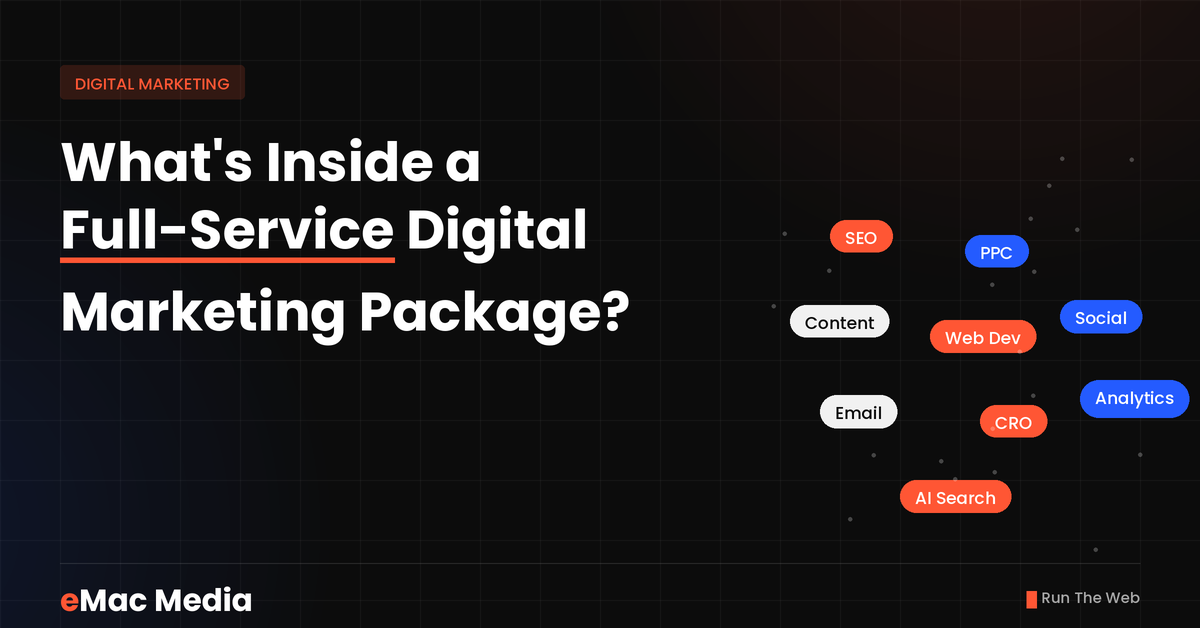
Any agency calling itself full-service in 2026 should deliver these eight core services. If they cannot check every box or subcontract most of them out, they are a specialist agency wearing a bigger hat.
| Service | What It Delivers |
|---|---|
| SEO & AI Search | Organic rankings, AI Overview citations, technical health |
| Paid Media | Google Ads, Meta, LinkedIn, TikTok, retargeting |
| Content Marketing | Articles, guides, video scripts, lead magnets |
| Web Design & Dev | Site builds, redesigns, landing pages, Core Web Vitals |
| Social Media | Organic content, community management, influencer |
| Email & CRM | Automation flows, nurture sequences, lifecycle marketing |
| CRO | A/B testing, funnel optimization, landing page rebuilds |
| Analytics | GA4, dashboards, attribution, monthly reporting |
SEO and AI Search Visibility
Search is still the biggest organic growth channel for most businesses. Google alone processes billions of searches every day, and roughly two-thirds of all trackable web traffic starts in a search box. A full-service agency owns this channel end to end through its SEO services team.
What good SEO looks like in practice: technical audits that catch crawl issues, keyword and topic research tied to real revenue, on-page optimization, structured data and schema markup, page speed work, and content built around the queries your buyers actually type. This is the stable foundation that everything else builds on.
The change since 2023 is that SEO now runs alongside AI search visibility work, sometimes called AEO (answer engine optimization) or GEO (generative engine optimization). Google's AI Overviews now appear on a large share of informational queries. ChatGPT, Perplexity, and Claude are pulling real search traffic away from traditional results. The AI search visibility discipline is about showing up inside those generated answers, not just in blue links. Good agencies treat it as a layer on top of SEO, not a replacement for it.
Local businesses need a related but separate track: local SEO. That covers Google Business Profile optimization, local citations, review generation, and geo-targeted content. If you have a physical location or serve a defined service area, this work often produces the fastest revenue impact of any digital channel.
Backlinks and authority still matter too. Expect a real link building program with editorial placements from publications that would still exist without your outreach. Directory dumps and paid link farms are red flags.
Curious where your SEO actually stands?
Run the same checklist our team uses on every new client audit. It covers 45+ ranking factors across technical, content, and authority signals.
Paid Media and PPC
Paid media is the fastest way to buy attention. It also has the shortest half-life. Stop paying and the traffic stops the same afternoon. A full-service digital advertising team handles Google Search, Performance Max, YouTube, Meta (Facebook and Instagram), LinkedIn, TikTok, and programmatic display, plus retargeting across all of them.
The core work: audience research, campaign structure, ad creative, landing page alignment, bid strategy, conversion tracking, and daily optimization. Bad PPC agencies set up campaigns and let the platform algorithms run wild. Good ones treat every dollar of ad spend as a testable hypothesis and kill what doesn't work quickly.
Ad spend usually sits on top of the agency fee, not inside it. If someone quotes you a flat "$5,000 a month including ads," ask what portion is actually media and what portion is management. Reasonable management fees run 10 to 20 percent of spend for larger budgets, or a flat retainer for smaller accounts where percentage pricing would be too low to cover the work.
Content Marketing
Content is the fuel that makes SEO, email, social, and paid nurture all work. Without it you have distribution channels with nothing to distribute. A full-service content marketing engine produces articles, long-form guides, video scripts, podcast content, lead magnets, sales enablement, and the internal linking structure that pulls it all together.
Volume matters, but relevance matters more. Fifty AI-generated articles ranking for nothing help no one. Twelve deeply researched pieces built around commercial-intent queries can drive a business. Ask any agency you interview to show you three articles they published for a real client and the traffic those articles now earn. If they can't, they either don't do content or they don't measure it.
Web Design and Development
Your site is the destination for every other channel. If it loads slowly, breaks on mobile, or buries the offer, everything upstream gets more expensive. A full-service web development team can build a new site, redesign an existing one, or ship landing pages for specific campaigns without a three-month runway every time.
Core Web Vitals are table stakes now. Largest Contentful Paint under 2.5 seconds. Interaction to Next Paint under 200 milliseconds. Cumulative Layout Shift under 0.1. Google uses these as ranking signals and users bounce off pages that miss them. Ask about page speed in the first conversation.
For online stores, you also want ecommerce depth, meaning Shopify, WooCommerce, or headless builds that handle catalog size, checkout optimization, and product schema. UX matters everywhere but nowhere more than checkout. A good UX and design team can lift conversion rates by double digits just by removing friction that everyone else had gotten used to.
Social Media Management
Organic social does two jobs. It builds brand familiarity so paid ads convert better, and it gives you distribution for content that would otherwise sit unseen. A full-service social team handles content strategy, calendar planning, creative production, community management, and paid amplification.
The channel mix depends on your buyers. B2B tends to lean LinkedIn and increasingly YouTube. DTC and lifestyle brands live on Instagram, TikTok, and Pinterest. Local service businesses often get more from a healthy Google Business Profile and a small but active Facebook presence than from chasing TikTok trends. A good agency will tell you which platforms to skip.
Email, CRM, and Marketing Automation
Email is the highest-ROI channel most brands own. It's also the most neglected. A CRM and marketing automation team sets up welcome flows, abandoned cart or lead nurture sequences, re-engagement campaigns, and lifecycle marketing that runs on autopilot after the initial build.
The work overlaps with sales more than any other channel. If your CRM is disconnected from your marketing platform, or your email list has been sitting untouched for a year, this is where a full-service agency will usually find the biggest quick wins. Klaviyo, HubSpot, ActiveCampaign, GoHighLevel, Salesforce Marketing Cloud, all of them can be wired into the same content and paid strategy running everywhere else.
Conversion Rate Optimization
Getting traffic is only half the equation. Converting it is the other half. Revenue marketing and CRO work uses heatmaps, session recordings, form analytics, and A/B tests to find where visitors drop off and rebuild those moments. Small changes to a button, a headline, or a form field can move revenue meaningfully without spending another dollar on media.
Good CRO is boring in the best way. It's disciplined, hypothesis-driven, and measured. Bad CRO is a designer shipping "improvements" based on personal taste. Ask any agency you interview to walk you through the last three tests they ran, what they learned, and what they shipped as a result.
Want a coordinated strategy across every channel?
Book a free 30-minute consultation with our team. We'll audit your current stack and show you where the biggest wins are hiding.
Analytics, Attribution, and Reporting
If you don't know what's working, none of the above matters. A full-service agency owns your GA4 setup, event tracking, conversion goals, dashboarding, and monthly reporting. Better shops also handle attribution modeling so you can tell whether that paid social spend really drove the sale or if organic search deserves the credit.
Reports should tell you what changed, why it changed, and what the team is doing about it next month. If your monthly report is a screenshot of GA4 with no commentary, you're paying for data delivery instead of strategy.
Specialized Add-Ons Worth Asking About
Beyond the core eight, most full-service agencies offer a handful of specialized services that make sense for certain brands. These are worth asking about even if they seem tangential:
- Digital PR: earned media placements that drive both traffic and high-authority backlinks
- Online reputation management: review generation, brand monitoring, and crisis response
- Amazon SEO and PPC: a separate discipline from Google, with its own algorithm and ad platform
- Influencer marketing: creator partnerships, deliverable management, performance tracking
- Video production: short-form for social, long-form for YouTube, product video for ecommerce
- Marketing operations: connecting the tools in your stack so data actually flows between them
- Fractional CMO or marketing leadership: strategy support without a full-time hire
How Pricing Actually Works
Full-service digital marketing agencies price in a few common ways. Understanding which model you're being sold matters more than the sticker number.
Typical monthly retainer ranges as of 2026:
| Business Size | Typical Monthly Range | What's Usually Included |
|---|---|---|
| Small local | $3,000 to $6,000 | Local SEO, GBP, basic PPC, light content |
| Growing SMB | $6,000 to $12,000 | SEO, PPC, content, email, monthly reporting |
| Mid-market | $12,000 to $25,000 | Full core plus social, CRO, AI search, dedicated team |
| Enterprise | $25,000+ | Everything, plus strategy leadership and specialist channels |
Ad spend is almost always separate from the retainer. A brand paying a $10,000 retainer might have another $30,000 flowing to Google and Meta directly. Contract length varies. Six-month minimums are common. Twelve-month engagements are standard for larger scopes because SEO and content need runway to compound.
When a Full-Service Agency Beats Hiring Specialists
Full-service is not always the right answer. There are cases where hiring a boutique specialist makes more sense.
Go full-service when you need coordinated growth across multiple channels, your internal marketing team is small or nonexistent, you don't want to manage five different vendors, or you value having one strategic partner who understands the whole business. This describes most companies between $2M and $50M in annual revenue.
Go specialist when you already have strong in-house strategy, you only need one channel executed exceptionally well, or you're testing a new channel and want the sharpest possible operator for that specific test. Enterprise brands often blend both, using a full-service agency of record for coordination and specialist shops for individual channels.
How to Evaluate a Full-Service Agency
The pitch decks all look identical. Everyone claims data-driven, ROI-focused, results-oriented, and every other adjective the industry has trained itself to use. Here's what actually separates real full-service partners from generalists in a nice suit.
- Ask for named case studies. Not "a client in your industry." A real client name, a real challenge, and real numbers. If they cannot share that after signing an NDA, they either haven't done the work or the results weren't good.
- Ask who does the work. Some agencies sell you on a founder or senior strategist and then hand your account to a junior. Ask who will be in your weekly meetings, who writes your content, and who runs your ads. Get names.
- Ask about their AI search approach. If they don't have an answer for how they measure and improve visibility in ChatGPT, Perplexity, Google AI Overviews, and Claude, they are behind by at least a year.
- Ask what they would do in the first 30 days. A generic answer means a generic plan. A specific answer means they actually looked at your business before the meeting.
- Ask how they handle failure. Every campaign has a losing quarter. How does the agency react when the numbers slip? Do they change the plan, blame the market, or disappear until the next renewal call?
- Ask about reporting cadence. Weekly updates and monthly strategic reviews are standard. If they only surface every quarter, expect surprises.
Ask them to explain, in plain English, how the eight core channels connect to each other inside their model. If they cannot draw that map in under two minutes, they are not really running a full-service operation. They are running eight separate services and hoping the client does the integration.
Putting It All Together
A full-service digital marketing agency is not eight vendors in a trench coat. It's one team, one strategy, and one dashboard for every channel that touches your growth online. The core covers SEO and AI search, paid media, content, web design and development, social, email and CRM, CRO, and analytics. The good agencies add specialized services around the edges and coordinate everything so campaigns compound instead of competing.
The right partner for you depends on your stage, your team, and your appetite for coordination. If you have marketing leadership in-house and one channel that needs a specialist, hire the specialist. If you need every channel running well without becoming the strategy layer yourself, hire full-service. Just make sure the agency you pick can actually do the work under their own roof, not by subcontracting half of it out and marking up the invoice.
Frequently Asked Questions
References & Sources
- 1.How Google Search Works · Google
- 2.Core Web Vitals · web.dev by Google
- 3.AI Features in Google Search · Google Search Central
- 4.How to Hire a Marketing Agency · HubSpot
- 5.Marketing Budget Benchmarks · Gartner
- 6.Marketing Strategy Insights · Think with Google


Ready to run every channel from one team?
Since 2014, eMac Media has run 291+ campaigns across 200+ industries and generated over $50M in client revenue. See what a coordinated full-service partner can do for your growth.
Get the Free SEO Audit Checklist