

- Why Hiring the Right Agency Matters
- Define Your Goals First
- What Services to Look For
- SEO and Content
- Paid Media and PPC
- Web Design and Development
- How to Evaluate Track Records
- Red Flags to Watch For
- Questions for a Discovery Call
- Budget Considerations
- Freelancers vs. In-House vs. Agencies
- Measuring Agency Performance
- Making Your Final Decision
- FAQ
- References
Choosing a digital marketing agency is one of those decisions that feels straightforward until you start doing it. There are thousands of agencies out there, most of them saying the same things on their websites. This guide walks you through how to figure out what you actually need, how to separate credible agencies from the ones running on hype, and how to structure the relationship so both sides stay accountable. Whether you are spending $1,500 a month or $15,000, the evaluation process is largely the same.
Why Hiring the Right Agency Matters More Than You Think
Small businesses operate on tighter margins than enterprise companies. A bad agency hire does not just waste money. It wastes time you could have spent building the right marketing foundation, and it can set you back months or even a full year in competitive markets.
According to a 2025 Clutch survey, 45% of small businesses that outsource digital marketing to an agency reported being dissatisfied with their first engagement. The most common reasons were poor communication, unclear reporting, and results that never materialized. Half of those businesses switched agencies within 12 months.
The cost of switching is real. You lose institutional knowledge, you restart onboarding, and you absorb the ramp-up period all over again. Getting it right the first time saves more than money.
A wrong agency hire can cost a small business six to twelve months of lost progress. The vetting process you do upfront directly determines the ROI you get over the next year.
Define Your Goals Before You Start Searching
Before you look at a single agency website, get clear on what you want digital marketing to do for your business. "Get more customers" is not specific enough. You need to know which channels are most relevant, what your timeline looks like, and what a successful engagement would produce in measurable terms.
Start by answering these questions:
- Are you trying to generate leads, drive online sales, or build brand awareness?
- Do you need help with one channel (like SEO) or a full-service strategy?
- What is your monthly budget, and how long can you sustain it?
- Do you have an existing website that performs well, or does it need a rebuild?
- What does success look like in 90 days? In 12 months?
Writing this down before your first agency call gives you a reference point. It also helps you evaluate whether an agency is listening to your situation or just pitching their standard package.
If your website loads slowly, looks outdated on mobile, or has no clear conversion path, you may need web development work before any marketing campaign can perform. An honest agency will tell you that. A less honest one will take your ad spend and send traffic to a page that does not convert.
What Services Should a Digital Marketing Agency Offer?
Not every agency does everything, and that is fine. What matters is whether their service mix matches your needs. Here is a breakdown of the core digital marketing services and when each one makes sense for small businesses.
SEO and Content Marketing
Search engine optimization is the process of improving your website so it ranks higher in organic search results. For small businesses with limited ad budgets, SEO is often the highest-ROI channel over time because you are not paying for every click.
A good SEO agency will audit your site, research keywords your customers actually use, fix technical issues, and build content that targets those searches. They should also be thinking about AI search visibility, since tools like ChatGPT and Google AI Overviews are changing how people find businesses online.
Content marketing works hand in hand with SEO. Blog posts, guides, and resource pages bring in organic traffic, build trust, and support your sales process. The agency should be producing content that answers real questions your customers are asking, not generic filler articles written for search engines.
Paid Media and PPC
If you need leads or sales quickly, pay-per-click advertising on Google, Meta, or other platforms can deliver results within days. The tradeoff is that traffic stops the moment you stop spending.
Look for an agency that manages ad spend transparently. You should always know exactly how much is going to the platform versus the agency's management fee. Ask whether they use your own ad accounts (they should) and whether you retain access to all campaign data if you part ways.
Web Design and Development
Your website is the foundation of every digital marketing effort. If your site is slow, confusing, or not optimized for conversions, every dollar you spend driving traffic to it underperforms. A capable agency will evaluate your web design and development needs as part of any strategy conversation.
For small businesses launching or relaunching a site, look for agencies that build on platforms you can manage yourself (WordPress, Shopify) and that include ongoing support after launch.
Not sure which services your business needs?
Talk to our team about building a marketing strategy tailored to your goals and budget.
How to Evaluate an Agency's Track Record
Every agency claims to deliver results. The difference between a credible claim and a hollow one comes down to specifics. Here is what to look for:
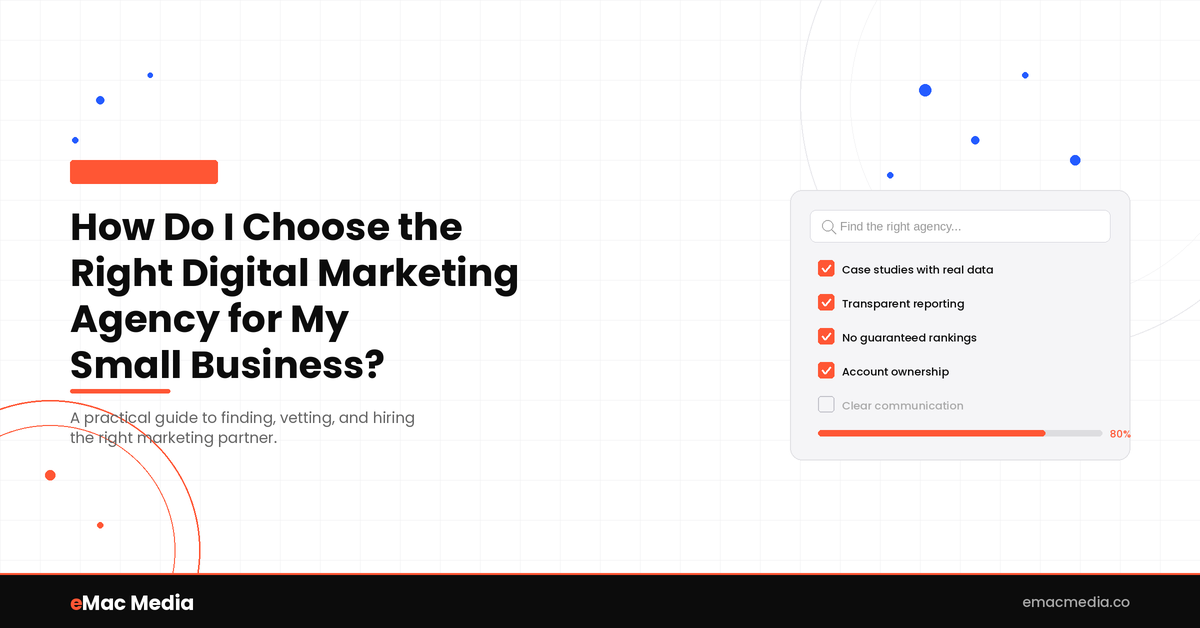
Case studies with real numbers. A good agency can show you documented client results with specific metrics: traffic growth percentages, revenue generated, rankings improved, conversion rates before and after. Vague testimonials like "they were great to work with" tell you nothing about performance.
Industry experience. An agency that has worked across multiple industries, say 200+, has likely encountered problems similar to yours. Industry-specific experience is a bonus, but the ability to apply conversion-focused strategies across different verticals matters more than deep niche expertise.
Client retention rates. Ask how long their average client relationship lasts. Agencies that retain clients for two years or more are doing something right. High churn usually signals delivery problems.
Reviews on third-party platforms. Check Clutch, Google Business Profile, and Trustpilot. Look for patterns in the reviews, not just star ratings. Multiple reviewers mentioning strong communication and clear reporting is a good sign.
| Evaluation Criteria | What to Look For | Red Flag |
|---|---|---|
| Case Studies | Specific metrics, named clients, timeframes | Only vague testimonials, no data |
| Industry Range | Experience across multiple verticals | Claims expertise in everything with no proof |
| Retention | Average client stays 2+ years | Avoids discussing client churn |
| Reviews | Consistent praise for communication and results | Reviews only on their own website |
| Transparency | Willing to show dashboards and reporting samples | Proprietary metrics you cannot verify |
Red Flags to Watch For When Evaluating Agencies
Knowing what to avoid is as important as knowing what to look for. These are the warning signs that an agency may not be the right fit, or may not be legitimate at all.
Guaranteed rankings. No agency can guarantee a #1 position on Google. Search algorithms change constantly, and anyone making that promise is either lying or using tactics that could get your site penalized. A reputable SEO agency will set realistic expectations and show you historical performance data.
No access to your own accounts. Your Google Ads account, your Analytics, your Search Console, your social profiles. All of these should be set up under your ownership with the agency granted access. If an agency insists on running campaigns from their own accounts, you lose everything if the relationship ends.
Long lock-in contracts with no performance clauses. A 12-month contract is not inherently bad. But it should include performance benchmarks and exit clauses if the agency consistently underdelivers. Month-to-month is ideal for starting out, but many agencies offer discounted rates for quarterly or annual commitments, which can make sense once you have confirmed the fit.
Lack of reporting transparency. You should receive regular reports (monthly at minimum) with clear metrics tied to your goals. If the agency pushes back on reporting frequency or sends reports full of vanity metrics like impressions and reach without tying them to revenue, that is a problem.
One-size-fits-all packages. Your business has specific needs. An agency that tries to sell you the same package they sell everyone else, without asking about your industry, competitors, or current marketing baseline, is not building a strategy. They are selling a product.
Questions to Ask During a Discovery Call
The discovery call is your best opportunity to evaluate whether an agency is the right partner. Come prepared with specific questions and pay attention to how they answer, not just what they say.
Here are the questions that matter most:
- Who will actually be working on my account? You want to know the team members, their experience, and whether you will have a dedicated point of contact or get shuffled between juniors.
- What does your onboarding process look like? A structured onboarding process with clear milestones (asset collection, strategy development, first deliverables) signals operational maturity.
- Can you walk me through a recent client result? Listen for specifics. What was the starting point? What actions did they take? What were the measurable outcomes? How long did it take?
- How do you handle communication and reporting? Ask about frequency, channels (email, Slack, calls), and what their reports include. You want to know before you sign.
- What happens if results are not meeting expectations? Good agencies have a process for this: strategy reviews, pivots, transparent conversations about what is working and what is not.
- What do you need from me to be successful? An agency that asks for access, brand assets, competitive context, and feedback timelines is planning to do the work properly. One that says "just leave it to us" may not be.
The best discovery calls feel like a two-way conversation, not a sales pitch. If the agency spends most of the call talking about themselves without asking about your business, that tells you something about how they will treat you as a client.
Ready to have that discovery conversation?
Book a call with eMac Media. No commitment, no pressure. Let us learn about your business first.
Budget Considerations for Small Businesses
Budget is the question everyone wants to answer first, and for good reason. Here is the honest truth: digital marketing services for small businesses typically range from $1,500 to $10,000 per month depending on the scope. SEO-only engagements tend to start around $1,500 to $3,000 per month. Full-service packages including SEO, PPC, content, and CRM automation run higher.
The SBA recommends that small businesses allocate 7 to 8% of gross revenue to marketing if they are doing less than $5 million in annual sales. That is a general guideline, not a rule. Businesses in competitive industries or growth phases often spend more.
What matters more than the dollar amount is the return. A $3,000/month engagement that generates $30,000 in new revenue is a better investment than a $1,000/month engagement that produces nothing measurable. Ask agencies how they track ROI and what kind of returns similar clients have seen.
Be cautious of agencies that price significantly below market. If an agency offers "full-service SEO" for $500/month, the work is either automated, outsourced to low-quality contractors, or spread so thin across clients that your account gets minimal attention.
The Difference Between Freelancers, In-House Teams, and Agencies
Small businesses generally have three options for marketing execution. Each has tradeoffs.
For most small businesses spending between $2,000 and $10,000 per month on marketing, an agency delivers the best combination of expertise, accountability, and scalability. You get strategists, writers, designers, and developers working on your account without paying six individual salaries.
If your budget is under $1,500 per month, a skilled freelancer in one specific area (like local SEO) may be the better fit until you are ready to scale.
How to Measure Agency Performance After Hiring
Hiring the agency is only the beginning. You need a system for tracking whether the engagement is producing results. Here is what to monitor.
Agree on KPIs upfront. Before the engagement starts, align on three to five key performance indicators. For SEO, that might be organic traffic growth, keyword rankings, and leads from organic search. For PPC, it could be cost per lead, ROAS, and conversion rate. Write these into the contract or statement of work.
Monthly reporting cadence. At minimum, your agency should deliver a monthly report that connects activity (what they did) to outcomes (what changed). Reports should include data from your analytics platforms, not the agency's proprietary dashboard where numbers might be cherry-picked.
Quarterly strategy reviews. Every 90 days, step back and evaluate the broader trajectory. Are you on track to hit annual goals? What is working? What should change? A good agency will proactively schedule these conversations.
Watch the leading indicators. Results in SEO take time, so do not panic in month two if rankings have not moved dramatically. But you should see leading indicators: indexation of new content, technical fixes being completed, backlinks being built, and a clear content calendar being executed. If nothing is happening in the first 60 days, that is a problem.
Making Your Final Decision
After evaluating agencies, talking to references, reviewing proposals, and sitting through discovery calls, you will likely have two or three finalists. Here is how to make the final call.
Compare proposals side by side. Create a simple spreadsheet with your evaluation criteria as rows and the finalist agencies as columns. Score each on services offered, pricing, communication quality, case study relevance, and overall fit. This removes some of the emotion from the decision.
Trust the communication quality. The way an agency communicates during the sales process is the best version of their communication you will ever see. If response times are slow, proposals are sloppy, or they dodge your questions now, it will only get worse after you sign.
Start with a defined scope. Rather than signing up for everything at once, consider starting with a focused engagement. A three-month ecommerce audit, a UX review, or an initial SEO sprint lets you evaluate the agency's work quality before committing to a longer-term retainer.
The right agency will feel like a partner, not a vendor. They will push back when your ideas do not make strategic sense, bring proactive recommendations, and treat your business like it matters to them. Because if it does not, you are just another line item on their client roster.
Frequently Asked Questions
Most small businesses allocate between 7% and 12% of gross revenue to marketing, with a growing share going to digital channels. The right amount depends on your industry, growth stage, and competitive landscape. A new business trying to build awareness will need to invest more heavily than an established one maintaining market share. Start with a budget you can sustain for at least six months, because most digital channels need time to gain traction.
SEO (search engine optimization) focuses on earning organic visibility in search results over time through content, technical improvements, and link building. PPC (pay-per-click) delivers immediate visibility by placing paid ads at the top of search results. SEO compounds over time and costs less per lead long term, while PPC generates traffic the moment your campaign goes live. Most small businesses benefit from running both in parallel.
It depends on the channel. PPC campaigns can drive traffic within days. SEO typically takes three to six months before organic rankings and traffic improve meaningfully. Social media and content marketing fall somewhere in between. Any agency promising overnight results, especially for SEO, is overpromising. Ask for realistic timelines tied to specific KPIs before you sign a contract.
Both can work well. Local agencies offer face-to-face meetings and may understand your regional market better, which matters for local SEO and geo-targeted campaigns. Remote agencies give you access to a wider talent pool and can often offer more competitive pricing. The deciding factor is communication quality and responsiveness, not geography. Ask about their communication cadence and tools before making a decision.
A solid contract should cover scope of services, deliverables and timelines, reporting frequency, payment terms, contract length and cancellation policy, intellectual property ownership, and confidentiality clauses. Make sure you retain ownership of all accounts, ad data, and creative assets. Avoid contracts that lock you in for more than six months without a performance review clause.
References & Sources
- 1 Small Business Digital Marketing Survey 2025 - Clutch
- 2 Marketing and Sales - U.S. Small Business Administration
- 3 Digital Marketing Pricing: How Much Does Digital Marketing Cost in 2026? - WebFX
- 4 Digital Advertising Spending by SMBs - Statista
- 5 About Google Ads Account Access and Ownership - Google Ads Help
- 6 How Much Should You Spend on Marketing? - HubSpot
- 7 How Much Does SEO Cost? Pricing Models and Factors - Search Engine Journal
- 8 How to Hire a Digital Marketing Agency - Forbes Advisor


Find the Right Marketing Partner for Your Business
eMac Media has driven $50M+ in client revenue across 200+ industries since 2014. Let us show you what the right agency relationship looks like.
Get Your Free Strategy Proposal