
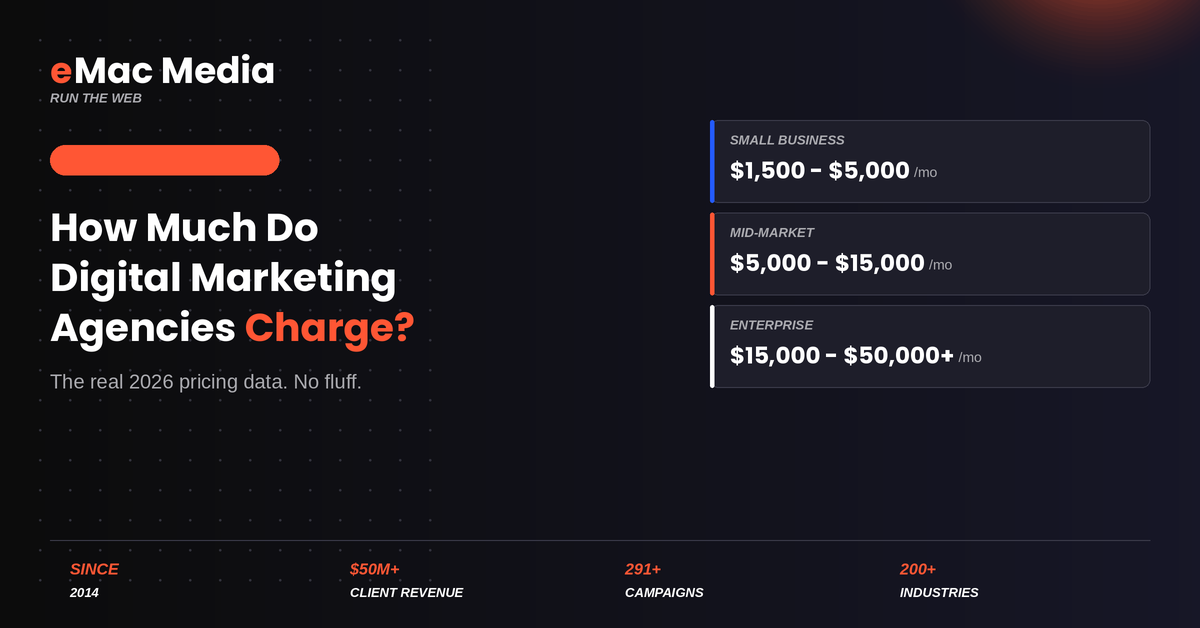





Full service digital marketing agencies charge $2,500 to $15,000 per month on average in 2026, with small businesses landing at $1,500 to $5,000, mid-market companies at $5,000 to $15,000, and enterprise programs starting at $15,000 and running past $50,000. Ad spend on Google, Meta, and other platforms is billed on top. The wide spread hides five different pricing models and 3x variance in scope. This guide breaks down what you actually pay for at each tier.
The Quick Answer
Full service digital marketing agencies charge $2,500 to $15,000 per month for most businesses in 2026. That is the honest, non-fluffy range where legitimate work happens.
Underneath that, there is a real spread. Small businesses running one or two channels pay $1,500 to $5,000. Mid-market companies running integrated programs across SEO, paid, content, and analytics land at $5,000 to $15,000. Enterprise brands with multi-channel programs in competitive verticals start at $15,000 and often exceed $50,000 per month.
Databox research found that 38% of agencies charge between $1,001 and $2,500 per month, but that number is dominated by single-channel work, freelancers, and boutique shops serving very small businesses. The full service tier, where you get strategy, execution, and reporting across multiple channels, sits higher.
If someone quotes you $500 a month for full service digital marketing, they are selling you task execution by a junior with no strategy attached. If someone quotes you $30,000 to start, they are either enterprise-scale or overpricing your engagement. The honest middle for most growing businesses is $3,500 to $10,000 per month.
What Full Service Actually Means
"Full service" is one of the loosest terms in the industry. Two agencies quoting $6,000 per month can have completely different definitions of what they deliver. Before comparing prices, get specific about what is inside the retainer.
A real full service digital marketing engagement usually covers the following channels working together:
- Search engine optimization including technical SEO, on-page work, content optimization, and link building. This is the compounding foundation of every strong program.
- Paid media across Google Ads, Meta, LinkedIn, and increasingly TikTok, with a clear split between management fees and ad spend.
- Content marketing, meaning strategy, writing, publishing, distribution, and internal linking.
- Social media management covering platform-specific content calendars, community management, and reporting.
- Email marketing and CRM automation for lead nurture, retention, and lifecycle campaigns.
- Analytics, attribution, and reporting with a real monthly review, not a screenshot of Google Analytics.
- Strategy and account management including a dedicated strategist and a documented quarterly plan.
Modern agencies increasingly add AI search visibility, digital PR, conversion rate optimization, and web development to the mix. Ask what is in and what is out before you compare retainer numbers.
Pricing by Business Size
The most useful way to benchmark is by your own business stage, because the underlying dynamics change as you scale. An SMB retainer involves a small team with broad responsibilities per person. An enterprise engagement involves specialists, senior strategists, and layered account management.
| Business Size | Monthly Investment | What You Get |
|---|---|---|
| Startup / Very Small Business 1-10 employees |
$500 - $2,000 | Freelance or entry-level agency. One or two channels. Basic execution, minimal strategy. Often junior-only staffing. |
| Small Business 10-50 employees |
$1,500 - $5,000 | Focused one to two service retainer. Local SEO plus social, or standalone PPC. A fractional marketing team, not a full one. |
| Small-to-Mid 50-100 employees |
$3,500 - $8,000 | Full service small business package with SEO, PPC, social, content, analytics, and monthly strategy. Dedicated account manager. |
| Mid-Market 100-1000 employees |
$5,000 - $15,000 | Integrated multi-channel program with senior strategist, dedicated AM, content production, and full attribution setup. |
| Enterprise 1000+ employees |
$15,000 - $50,000+ | Custom scope with multiple specialist teams. Often several agencies working in parallel. Custom SLAs and dedicated pods. |
The 3 to 5 percent of annual gross revenue rule is a useful cross-check. A $1 million revenue business should expect to invest roughly $2,500 to $4,200 per month in marketing. A $10 million business is looking at $25,000 to $42,000 per month across agency fees and ad spend combined.
Not sure which tier fits your growth goals?
We size retainers to what you actually need, not what looks impressive on a proposal. Get a straight quote based on your real revenue targets.
The 5 Pricing Models
Full service agencies use five main pricing structures. The one you sign under changes what you own, what you owe, and how flexible the engagement is when your priorities shift.
1. Monthly Retainer
The dominant model for ongoing work. You pay a recurring monthly fee for a defined scope of deliverables and hours. Retainer prices in 2026 range from $1,000 at the entry level to $25,000+ for enterprise. Predictable budgeting on both sides, but rigid when your priorities move fast. Most retainers require a 3 to 12 month commitment.
2. Hourly Billing
Best for one-off engagements like a technical SEO audit or a competitive analysis. Boutique agencies charge $100 to $300 per hour. Mid-tier agencies run $125 to $275. Enterprise agencies bill $175 to $500 or more. Hourly feels flexible upfront but expands quickly when scope is not locked. Wrong model for compounding channels like SEO or paid media.
3. Project Based Fixed Fee
Defined scope, defined timeline, defined deliverable, defined price. Common for website builds, SEO audits, and campaign launches. Great for one-time work. Not a fit for ongoing channels.
4. Performance Based Pricing
Fees tied to results such as leads, revenue, or rankings. Growing but still a minority of agency agreements because attribution is messy and agencies do not want to eat the risk of a broken sales funnel they do not control. Structures include revenue share of 3 to 10 percent of attributed sales, or per-lead pricing on top of a smaller base fee.
5. Hybrid Model
Most agencies in 2026 are moving toward hybrid structures that combine a predictable base retainer with performance incentives. This is where accountability meets sustainability. You pay a base for the team, and an upside kicks in when the numbers hit.
Service by Service Breakdown
When an agency bundles five services into a single number, use these benchmarks to check whether each component is priced fairly. All ranges are 2026 U.S. figures.
| Service | Monthly Range | Notes |
|---|---|---|
| SEO | $1,500 - $10,000 | The meaningful range. Local SEO starts at $800. Enterprise SEO runs $15,000+. Widest variance of any service. |
| PPC Management | $1,500 - $5,000 + 10-20% of ad spend |
Flat fee under $10K in ad spend. Percentage-based at higher spend. Never includes the actual media budget. |
| Content Marketing | $1,000 - $15,000 | Entry packages cover strategy plus limited output. Enterprise programs with senior writers, video, and distribution run higher. |
| Social Media Management | $1,000 - $5,000 | Lower for one or two platforms. Higher for full content production plus paid social. |
| Email / CRM Automation | $1,000 - $8,000 | Depends on list size, automation complexity, and lifecycle depth. |
| Link Building / Digital PR | $2,000 - $10,000 | Priced per placement or per campaign. Depends on target DR and outreach volume. |
| CRO / Landing Pages | $2,500 - $10,000 | Includes hypothesis, build, test, and analysis. Usually a 4 to 8 week sprint model. |
| AI Search Visibility (GEO/AEO) | $2,000 - $8,000 | Newer category. Focuses on visibility inside ChatGPT, Perplexity, Google AI Overviews, and other LLM surfaces. |
Bundling usually earns you 10 to 25 percent off individual service pricing. Bundling only makes sense if the agency executes well in every service you are bundling. A $3,000 discount on a channel the agency is weak at is not a discount.
What Actually Drives the Price
Two agencies quoting $2,500 and $7,000 for what looks like the same scope are not lying to you. They are staffing the engagement differently, allocating different senior time, and building in different margins. Here is what the math looks like underneath.
Labor and Team Seniority
A typical marketing specialist's fully loaded cost, which includes salary, benefits, overhead, and margin, runs roughly $75 to $150 per hour depending on experience. A $2,000 monthly retainer at $100 per hour gets you about 20 hours of work. A $5,000 retainer buys approximately 50 hours. A $10,000 retainer buys 100 hours or a small team.
That math tells you what to expect. Twenty hours a month is enough for basic monitoring and monthly reporting. Fifty hours starts to include real strategy sessions and meaningful optimization. One hundred hours is where dedicated management, content production, and cross-channel coordination become possible.
Scope and Channel Count
Every additional channel multiplies coordination overhead. Running SEO alone is one strategy, one report, one review cycle. Running SEO plus PPC plus content plus social plus email is five strategies that need to talk to each other, one attribution model, and a strategist senior enough to coordinate. This is why full service programs cost 2 to 3 times what single-channel retainers cost, not because agencies pad the number.
Market and Vertical Competition
A local plumber in Miami and a fintech SaaS competing nationally are running fundamentally different SEO programs. The plumber's SEO retainer might be $1,500. The fintech's might be $12,000. Same service line, different market pressure. Competitive verticals like legal, medical, finance, and B2B SaaS carry price premiums because the content bar is higher and the link acquisition math is harder.
Geographic Cost Structure
A NYC or SF agency has a different rent, salary, and overhead structure than a Miami or Austin agency, and both differ from an offshore team. Same scope, 30 to 60 percent price difference. What matters is not the ZIP code but the quality of senior thinking you get for the price.
Curious what your budget actually buys?
We run the math openly on every proposal, including labor hours, channel mix, and expected pipeline impact. No hidden margin.
Hidden Costs to Watch For
The retainer number on the proposal is rarely the total you pay. Ask about these five costs before you sign.
Platform and Media Fees
Ad spend on Google, Meta, LinkedIn, TikTok, and other platforms is always billed directly by the platform and is never included in a management fee. A $4,000 monthly PPC retainer that requires $15,000 in ad spend is a $19,000 monthly commitment. If an agency is vague about this, that is a red flag.
Third Party Tool Subscriptions
SEO platforms, reporting dashboards, and keyword research tools have real monthly overhead. Ahrefs, Semrush, and similar tools run $100 to $500+ per month at the tiers that support client work. Ask whether tools are bundled into the retainer, passed through at cost, or expected to be paid separately.
Onboarding and Setup Fees
One time fees for account setup, technical audits, tracking configuration, or onboarding commonly range from $500 to $3,000 for SMB engagements. Usually disclosed. Not always disclosed proactively.
Overage Charges
Hours-based retainers generate overage charges when work exceeds the agreed threshold. A retainer sold as "up to 40 hours per month" quietly becomes a variable cost when the account manager treats 40 as the floor.
Contract Renewal Increases
Annual renewal price increases of 5 to 15 percent are standard. Some agencies build in automatic escalators. Read the renewal clause and negotiate a cap on annual increases before you sign.
How to Know You Are Getting Value
Price is what you pay. Value is what you get, and value is measurable if you know what to measure.
Return on Ad Spend and Return on Investment
Well-managed mid-market retainers typically target 3 to 10 times annual ROI on agency and media spend combined, depending on margin structure and sales cycle. If your agency cannot show you attributed pipeline or revenue after 6 to 8 months, the value is not there.
Time to First Meaningful Result
Every channel has a different curve. Paid ads should show pipeline or revenue within 2 to 4 months. SEO and content usually deliver noticeable improvements in the same window and compounding gains in months 4 through 8. If nothing has moved by month 6, the strategy or the execution is broken.
Strategy vs Execution Ratio
Ask what percentage of your retainer goes to strategy versus execution. A healthy full service engagement is roughly 20 percent strategy, 70 percent execution, and 10 percent reporting. Retainers that are 80 percent execution are outsourced task lists, not marketing partnerships.
Reporting Cadence and Transparency
Monthly reports with real narrative, not just screenshots. Access to your own accounts. Weekly or bi-weekly stand-up cadence. A quarterly business review with a real roadmap for the next 90 days. If your agency ghosts you between invoices, you are paying for silence.
Ownership and Portability
Your content, your accounts, your data, your assets. Everything the agency produces on your behalf should be owned by you and portable if the relationship ends. If any agency treats ownership as a negotiation point, walk.
The eMac Media Approach
We have run more than 291 campaigns across 200+ industries since 2014 and generated $50 million+ in client revenue. Our pricing lives in the honest middle of the market because we build fractional marketing teams that combine SEO, AI search visibility, content, paid media, and CRO in one program.
Most full service engagements with us fall between $4,500 and $12,000 per month depending on scope, competition, and speed targets. Single-channel work starts lower. Enterprise programs go higher. Every proposal shows the labor hours, the channel mix, and the expected pipeline impact.
We use a five-step framework called DRIVE: Discover, Research, Implement, Validate, Evolve. It is how we scope pricing to real work instead of retainer inertia. If a channel stops earning its keep, we say so. If a new channel makes sense, we propose it with the math. That is the deal.
A construction client on a $6,500 monthly retainer with us runs local SEO across 4 cities, a monthly content program, Google LSA management, and quarterly digital PR. Ad spend is separate and runs about $4,500 per month. Combined investment: $11,000. Attributed pipeline in the first 12 months exceeded 8x that combined spend.
Frequently Asked Questions
References & Sources
- 1.Digital Marketing Pricing 2026: What Agencies Charge | Digital Applied
- 2.Marketing Agency Retainer Pricing: Complete Guide 2026 | Clicks Geek
- 3.Digital Marketing Agency Pricing in 2026 | NewMedia.com
- 4.Digital Marketing Agency Cost: 2026 Pricing Breakdown | Brand Leap
- 5.6 Proven Digital Marketing Agency Pricing Models 2026 | Taskip
- 6.Digital Marketing Agency Pricing Guide 2026 | InfluenceFlow
- 7.Content Marketing Agency Pricing 2026 | Column Five Media
- 8.Digital Marketing Cost Guide 2026 | GoodFirms
- 9.Marketing Agency Pricing By Business Size 2026 | FBD Agency
- 10.Marketing Agency Cost: Pricing Guide 2026 | WebFX
- 11.Digital Marketing Agency Pricing: Retainers, % of Spend, and Hybrid Fees | Scopic
- 12.Marketing Agency Monthly Retainer Cost: 2026 Guide | Clicks Geek


Ready for a Real Number on Your Marketing?
We build fractional marketing teams that cover SEO, AI visibility, content, and paid media in one program. See what your budget actually buys.
Get Your Free Strategy ProposalNot sure what marketing ROI to expect at your budget? Try our SEO ROI Calculator to model the return on your investment before you sign anything.