
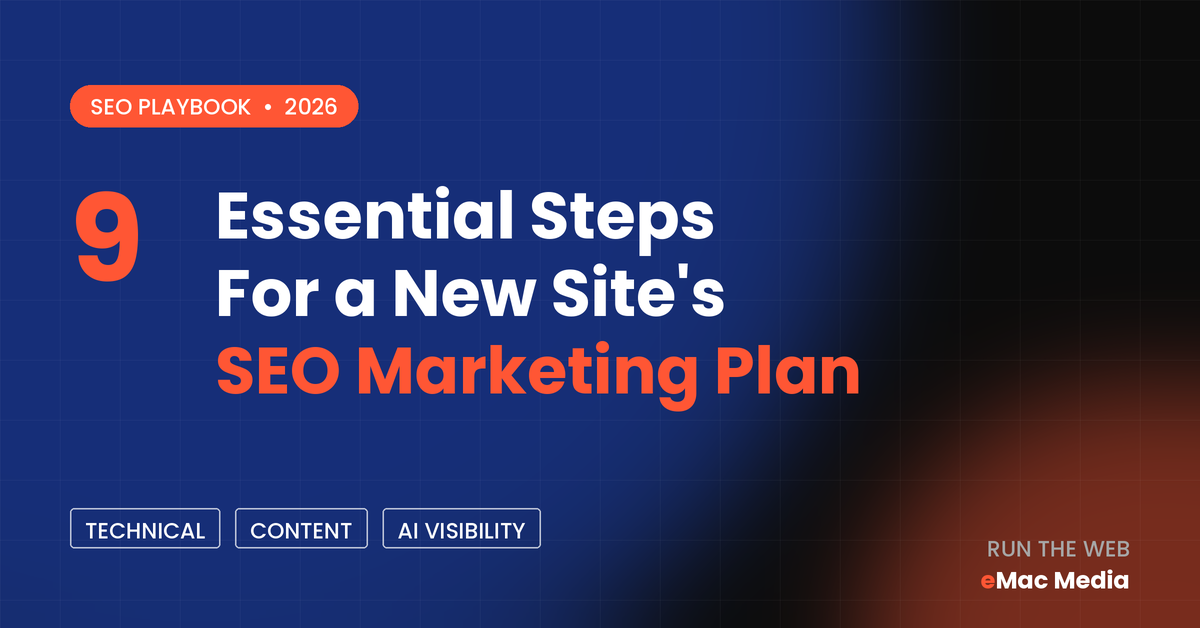




A good SEO marketing plan for a new website is really nine coordinated workstreams: technical foundation, keyword research, site architecture, content, AI search visibility, local SEO where relevant, link building, analytics, and a phased rollout. Skip any one of them and the whole thing wobbles. This guide walks through each step in the order we run them for clients, with the exact deliverables and the timeline you should expect.
Why a New Website Needs an SEO Plan From Day One
Most new sites launch, sit quietly for six months, then get retrofitted with SEO. That is the expensive way to do it. Fixing site architecture, URL structure, and thin content after the fact usually costs more than doing it right the first time, and you lose the ranking runway.
Google indexes roughly a trillion pages and shows ten of them on page one. On top of that, AI Overviews, ChatGPT, Perplexity, and Gemini now answer a growing share of queries before anyone clicks through. A new site starting from zero has no authority, no history, and no reason for search engines to trust it yet. The plan below is designed to shorten that trust-building window from years to months.
The framing question to keep in mind: what would a search engine (or an LLM) need to see on your site, and around your site, to confidently recommend you? Everything else flows from there. Our team runs this exact plan through our managed SEO services, and the sequence matters as much as the tactics.
Step 1: Nail the Technical Foundation
Before you publish a single blog post, your technical setup has to be clean. Search engines will not rank pages they cannot crawl, index, or render properly, and AI systems will not cite them. The checklist here is short but non-negotiable.
Crawlability & Indexing
Submit an XML sitemap to Google Search Console and Bing Webmaster Tools on launch day. Set a clean robots.txt that blocks admin, cart, and staging paths but leaves everything else open. Verify that key templates return a 200 status code and that pagination, canonicals, and hreflang (if you have multiple regions) are set correctly.
Core Web Vitals & Page Speed
Google uses page experience as a ranking signal, and Core Web Vitals are the measurable piece: LCP under 2.5 seconds, INP under 200 ms, CLS under 0.1. Compress images, use a modern format like WebP or AVIF, defer non-critical JavaScript, and put a CDN in front of the site. A slow site kills rankings and conversions at the same time. Our web development team ships new sites with these targets baked in from the first build.
Mobile-First & Accessibility
Google indexes the mobile version of your site, so mobile is not a courtesy render, it is the render. Make sure tap targets are large enough, text is legible without zoom, and no layout breaks on common viewport sizes. Accessibility (alt text, semantic HTML, proper heading order) also correlates with better rankings because it makes content easier for crawlers to parse.
HTTPS, Security & Schema
HTTPS is table stakes. Beyond that, add Organization, WebSite, and BreadcrumbList schema on launch, and layer in Article, Product, LocalBusiness, or FAQ schema where they fit. Structured data is one of the biggest levers for AI Overview citations right now.
A new site that ranks in 6 months is a site that got the technical work done in the first 30 days. Everything downstream, from content velocity to link building, sits on top of this foundation.
Step 2: Keyword Research & a Topical Map
Keyword research on a new site is not about finding the highest-volume terms and going after them. It is about finding the queries you can actually win in the first 6 to 12 months, then building outward from there.
Start With Bottom-of-Funnel and Long-Tail
New sites should target long-tail keywords (4+ words, lower volume, higher intent) and bottom-of-funnel commercial queries first. These have less competition, convert better, and give you early wins that compound authority. A tool like Ahrefs, Semrush, or Google's Keyword Planner is fine to start; what matters is filtering for terms with keyword difficulty under 20 to 30 for your first 90 days.
Build a Topical Map, Not a Keyword List
A flat list of 200 keywords is not a strategy. Group your keywords into topical clusters: one pillar topic that owns the head term, then 8 to 15 supporting articles that cover subtopics and long-tail variants. This structure signals topical authority to Google and gives AI systems a coherent set of pages to cite.
Match Intent, Not Just Words
For every target keyword, look at what already ranks. If the top ten results are all product pages, a blog post will not break through, no matter how good it is. Match the intent (informational, commercial, transactional, navigational) or pick a different target.
This is also where you decide which queries are worth chasing with a content marketing program versus which need a dedicated landing page or product page.
Not sure which keywords your new site can realistically win?
Our team runs a full keyword and competitor audit as part of every SEO engagement, so you launch with a target list you can actually rank for.
Step 3: Site Architecture & On-Page SEO
Site architecture is the map that tells search engines what your site is about and which pages are most important. Get this wrong and even great content will underperform.
Keep the Hierarchy Flat
Every page on your site should be reachable within three clicks from the homepage. Deep, nested folder structures dilute link equity and slow down indexing. Use clean, descriptive URLs (like /services/local-seo/ rather than /page?id=482).
Internal Linking Is Free Ranking Fuel
Internal links pass authority, help Google understand relationships between pages, and keep users on the site longer. Every new article should link to 2 to 4 relevant existing pages, and get linked to from at least one high-authority page in return. Do not leave orphan pages: if a page has no internal links pointing to it, it might as well not exist.
On-Page Essentials
Each page needs a unique title tag (under 60 characters, primary keyword near the front), a compelling meta description (under 160 characters), one H1 that includes the target keyword, and a clean heading hierarchy (H2 for main sections, H3 for subsections). Use the keyword naturally in the first 100 words and in at least one image alt attribute.
Image Optimization
Every image needs a descriptive filename, compressed file size, and meaningful alt text. Lazy-load images below the fold. Skipping this is one of the fastest ways to tank Core Web Vitals.
Step 4: Build a Real Content Strategy
Content is where most new sites either accelerate or stall. The mistake is treating it as a volume game. Publishing 40 mediocre articles will do less for your rankings than publishing 10 that are genuinely the best answer on the internet for their query.
Pillar and Cluster Model
For each topical cluster from Step 2, publish one long-form pillar page (2,500+ words) that comprehensively covers the head term. Then publish supporting articles that link back to the pillar. This creates a semantic mesh that both Google and LLMs read as topical authority.
Publishing Cadence
A realistic cadence for a new site is 2 to 4 articles per week for the first 90 days, then adjust based on results. Consistency beats volume. A site publishing 2 great pieces every week for a year will outrank one that dumps 100 posts in month one and goes quiet.
Content Quality Signals
Google's Helpful Content system and E-E-A-T guidelines reward content that shows real experience, is written or reviewed by a named expert, cites primary sources, and answers the query fully. Every article should have a bylined author with credentials, links to authoritative sources, and original insight (a stat you calculated, a case study, a quote from someone in the field).
Refresh, Not Just Publish
SEO content is not one-and-done. Plan to refresh top-performing articles every 6 to 12 months: update stats, add new sections, tighten the intro, expand the FAQ. Refresh-driven traffic gains are often larger than net-new publishing.
Step 5: AI Search Visibility (GEO/AEO)
Traditional SEO gets you to page one. AI Search Visibility (also called Generative Engine Optimization or Answer Engine Optimization) gets you cited in ChatGPT, Perplexity, Gemini, and Google's AI Overviews. This layer sits on top of SEO, not next to it. You cannot skip the SEO fundamentals and jump straight here.
What LLMs Actually Cite
AI systems favor pages that are well-structured (clear headings, short paragraphs, direct answers near the top), rich in structured data, factually verifiable with citable sources, and consistently referenced by other trusted sites. Notice the overlap with classic SEO best practices. It is not a coincidence.
Structured Answers Near the Top
Lead each article with a direct, quotable answer to the query in the first 2 to 3 sentences. LLMs pull answers preferentially from the top of the page. Bury your answer at the bottom and you will not get cited.
Schema, Entities, and Brand Signals
Add every applicable schema type (Article, FAQ, HowTo, Product, LocalBusiness). Make sure your brand has a consistent presence across Wikipedia (where applicable), Wikidata, Crunchbase, and your industry's directories. LLMs use these signals to understand who you are and whether to trust you. Our AI Search Visibility service covers this end-to-end.
Test Your Visibility
Query ChatGPT, Perplexity, and Gemini for your target keywords monthly. See which sources they cite and which they do not. This is the AI-search equivalent of a rank tracker, and it should be part of your reporting from month one. You can also run your own domain through our free AI Visibility Score Calculator to see where you stand.
GEO/AEO builds on top of SEO. It does not replace it. Every AI-visibility win we have measured for clients started with a technically sound, well-structured site that Google already trusted.
Step 6: Local SEO (If You Serve a Geographic Area)
If your business serves a specific city, region, or set of neighborhoods, local SEO is the fastest ROI you will get. It is also the most straightforward.
Google Business Profile
Claim and fully complete your Google Business Profile: accurate NAP (name, address, phone), business hours, categories, service areas, photos, and a keyword-rich description. Post updates weekly. Respond to every review, positive or negative, within 48 hours.
Citations & NAP Consistency
Get listed in the major citation sources (Yelp, BBB, Apple Maps, Bing Places, Yellow Pages, your Chamber of Commerce, and industry-specific directories). Every listing must use the exact same NAP as your Google Business Profile. Inconsistencies confuse Google and hurt local rankings. Our free Local SEO Citation Audit Tool will show you where you are listed and where you are not.
Location Landing Pages
If you serve multiple cities, build a dedicated landing page for each one. Do not spin identical templates with the city name swapped in. Each page needs unique content: local case studies, city-specific service details, a map, and testimonials from customers in that market.
Reviews Are Ranking Signals
Volume, velocity, and recency of reviews all correlate with local pack rankings. Build a simple post-service review request flow (email or SMS) and make sure customers know exactly where to leave the review. Our local SEO service handles this alongside citation cleanup.
Ready to see your new site rank faster?
We have run this exact plan for 291+ campaigns across 200+ industries, generating over $50M in client revenue. Let's build yours.
Step 7: Link Building & Digital PR
Backlinks are still one of the top three ranking factors. For a new site with zero domain authority, this is the piece that takes the longest to build and pays off the most.
Start With Foundational Links
Before doing anything fancy, secure the obvious: your business directories, industry associations, partner sites, vendors, existing customers, and any organizations you sponsor. These are usually easy asks and give you a base of trusted referring domains.
Guest Posting & Contributed Content
Pitch original articles to reputable industry publications in your niche. The goal is not the link, it is the exposure and topical association. A byline on a well-known site in your industry is worth more than 50 low-quality directory links. Focus on sites with real editorial standards and audiences that overlap yours.
Digital PR for Authority
Original research, data studies, and expert commentary are the fastest way to earn high-authority links (HubSpot, Forbes, industry trade press). Commission a small proprietary survey, publish the results, and pitch journalists. One well-executed data study can generate 20 to 100 referring domains. Our link building team runs this playbook regularly for clients.
What to Avoid
Skip link farms, PBNs, mass guest post services, and anything advertised as "1,000 backlinks for $50." Google's Penguin algorithm and manual actions will penalize you, and the cleanup is expensive. If it looks like a shortcut, it is a trap.
Step 8: Analytics, Reporting & Iteration
An SEO plan without measurement is a hobby. Set up your analytics stack before you launch, not after.
The Essential Stack
Google Analytics 4 for user behavior, Google Search Console for organic performance and indexing issues, a rank tracker (Ahrefs, Semrush, or a lighter option like SerpRobot), and heatmap/session recording (Microsoft Clarity is free and excellent). Add server-side conversion tracking if you run paid alongside SEO.
Metrics That Matter
Organic sessions, non-branded impressions, keyword rankings for tracked terms, conversions from organic (leads, calls, purchases), average position, click-through rate, and pages indexed. Vanity metrics like domain authority are useful directional benchmarks but not KPIs.
Reporting Cadence
Weekly internal reviews (what changed, what's next), monthly client-style reports (traffic, keywords, links, wins, blockers), and quarterly strategy resets (what to double down on, what to kill). Numbers without narrative are useless. Every report should end with 2 to 3 specific actions.
Iterate on Winners
Once a page is ranking on page 2 or bottom of page 1, small improvements (adding a section, refreshing stats, improving internal links) often move it into the top 3. Prioritize refreshing near-miss pages over publishing new ones. This is where our SEO ROI Calculator comes in handy for pricing the effort against the expected traffic lift.
Step 9: The 30-60-90 Day Rollout
Here is how the nine steps above sequence in a realistic timeline for a new site. Adjust based on your team size and budget, but the order of operations rarely changes.
Days 1-30: Foundation
Technical audit and fixes. Site architecture finalized. Keyword research and topical map complete. Analytics stack live. Google Business Profile claimed and optimized (if local). Core schema markup deployed. First 4 to 8 pillar articles briefed and in production.
Days 31-60: Content Velocity
Publish 8 to 12 pieces of content across pillar and cluster topics. Begin internal linking audit. Launch foundational link building (directories, partners, associations). First round of citations for local businesses. Start monthly AI visibility testing across ChatGPT, Perplexity, and Gemini.
Days 61-90: Authority
Continue publishing at 2 to 4 pieces per week. Pitch first round of guest posts and PR-driven links. Launch first data study or original research piece. Refresh any early winners that are close to page 1. Full 90-day report with baseline vs current performance and a projection for months 4 to 6.
At day 90, you should have between 25 and 40 pages of quality content, a clean technical setup, 20 to 50 referring domains, and early rankings for low-competition terms. What you will not have yet is major traffic. That comes in months 4 to 9 if the foundation is right.
Frequently Asked Questions
References & Sources
- 1.SEO Starter Guide | Google Search Central
- 2.Core Web Vitals | web.dev
- 3.Introduction to Structured Data Markup | Google
- 4.Helpful Content Update | Google Search Central Blog
- 5.Improve Your Local Ranking on Google | Google Business Help
- 6.Spam Policies for Google Web Search
- 7.How Long Does SEO Take? | Ahrefs
- 8.What is Generative Engine Optimization (GEO)? | Search Engine Land


Want This Plan Executed for Your New Site?
Get a free SEO Audit Checklist covering every step above, then let our team build the roadmap tailored to your business.
Get the Free SEO Audit Checklist