
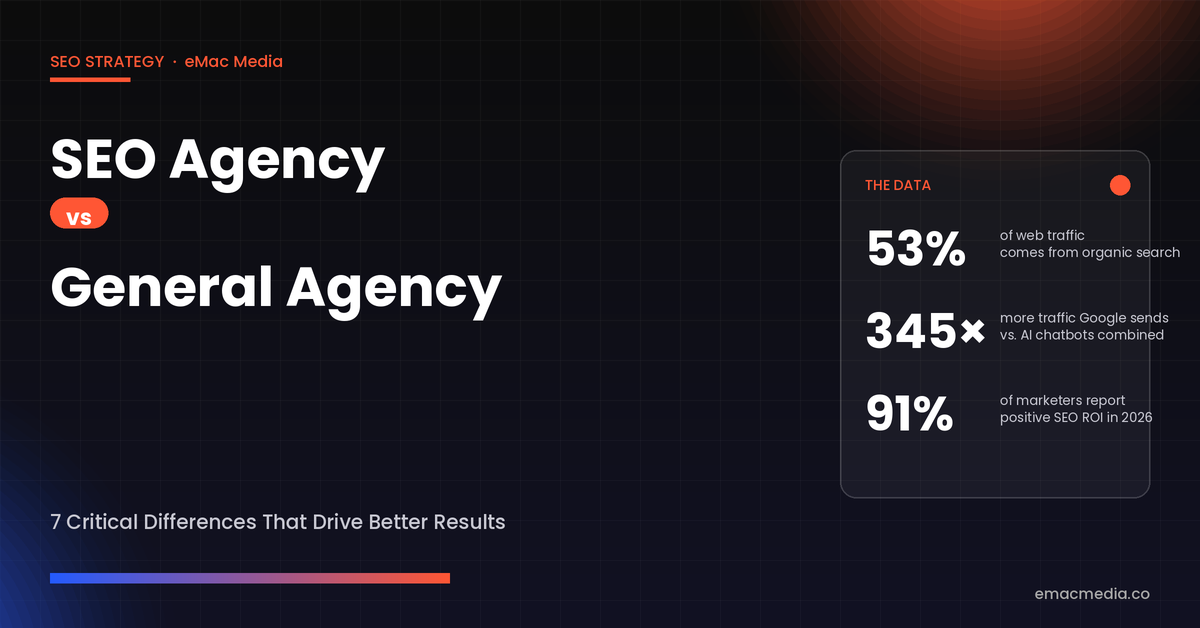




Both agency types will happily take your money. The difference shows up in what they do with it. A specialized SEO marketing agency lives inside Google Search Console, Ahrefs, and Screaming Frog every day and treats organic traffic as the whole product. A general marketing agency treats SEO as one line item on a media plan that also covers paid ads, social, email, PR, and events. If organic search is a real revenue channel for your business, the specialist almost always delivers more traffic per dollar. If you need one team to run the entire funnel and organic is a bonus, a generalist can work.
1. Where Their Attention Goes Every Day
This one difference explains almost everything else.
An SEO marketing agency wakes up thinking about ranking positions, indexation, click-through rates, and organic revenue. The account managers open Google Search Console before they open email. The strategists check ranking dashboards for algorithm volatility before the daily standup. Everyone on the team, from the analyst to the founder, spends 80%+ of their time on work that affects how a website performs in search results.
A general marketing agency has a wider mandate. On any given day the team is juggling a Facebook ad refresh, a print brochure, a trade show booth design, an email newsletter, a press release, and a landing page tweak. SEO gets a slot on the calendar. Sometimes it is a big slot. Usually it is not. The team member handling your SEO also handles four other things this week.
Neither model is wrong. If your business needs a single partner to run brand marketing across every channel, a generalist makes sense. If organic search matters enough that you would notice a 30% drop tomorrow, you want the team that would notice it before you do.
Ask any agency: "What percentage of your team's daily hours goes to SEO-specific work?" A specialist answers 80%+. A generalist answers 10-25%. The number tells you almost everything you need to know.
2. The Technical Work Generalists Skip
Technical SEO is where the difference gets expensive.
A specialist runs regular crawls with Screaming Frog or Sitebulb, checks server log files to see what Googlebot is actually doing, audits Core Web Vitals in Chrome UX Report data, and troubleshoots JavaScript rendering when pages fail to index. They know the difference between a canonical tag and an hreflang tag and when each one causes ranking problems.
Most general agencies handle meta titles and descriptions, install a plugin like Yoast or Rank Math, and call that "SEO." When something breaks at the crawl or render level, the account team escalates to a developer who does not specialize in search. The fix, if it happens, takes months. Meanwhile competitors keep climbing.
Here is a partial list of technical issues a specialized web development and SEO team catches routinely and a generalist often misses:
- Crawl budget waste on parameter URLs and faceted navigation
- Rendered vs. raw HTML mismatches on JavaScript-heavy sites
- Orphaned pages that get zero internal links
- Broken redirects and redirect chains draining link equity
- Schema markup errors that block rich results eligibility
- Mobile-first indexing gaps between desktop and mobile content
- Core Web Vitals failures on template-level components
- hreflang implementation errors on international sites
Every one of these can quietly cap your organic performance for months while the general agency reports on impressions and engagement rates.
Not sure what your site is missing?
Our free SEO Audit Checklist walks you through the same technical review our team runs on every new client, step by step.
3. Content Written for Search Intent, Not Just Brand Voice
A general marketing agency produces content around brand themes, product launches, and campaign moments. The editorial calendar starts with "what do we want to say this quarter" and works outward from there. The writing is often excellent. Whether anyone finds it in search is a secondary concern.
A dedicated content marketing team inside an SEO agency starts somewhere else entirely. The calendar starts with a keyword universe of 500 to 5,000 terms your customers actually search, mapped by intent (informational, commercial, transactional), volume, difficulty, and current ranking. Every brief includes the target keyword, the SERP analysis, the entities Google associates with the topic, the internal links to include, and the schema markup to apply.
The result reads like brand content when it is well done. Underneath the surface it is engineered to earn a specific set of rankings for a specific set of queries that add up to real revenue.
Consider what this looks like in practice. A general agency writes a beautiful blog post titled "The Evolution of Our Craft." A specialist writes "Best Time Tracking Software for Small Agencies in 2026" because 2,400 people search that phrase monthly and half of them are in a buying cycle. Both posts might be well written. Only one earns compounding traffic.
4. What Gets Measured and Reported
Reports from a general agency usually highlight impressions, reach, engagement rate, social followers, email open rates, and campaign clicks. These metrics reflect the work done. They rarely tie back to organic search performance in any deep way.
An SEO agency reports on a different stack: non-brand organic traffic, ranking distribution across priority keywords, share of voice against named competitors, assisted conversions from organic sessions, revenue per organic visitor, and pages gaining or losing traffic month over month. Layered with a revenue marketing and CRO program, these numbers tie back to the search channel specifically and to bottom-line revenue.
| Metric Type | General Agency Reports | SEO Agency Reports |
|---|---|---|
| Traffic | Total sessions, top channels | Non-brand organic sessions, landing page traffic, query-level growth |
| Rankings | Rarely tracked | Position tracking on 100-500 priority keywords, movement week over week |
| Authority | Media mentions, PR placements | Referring domains, DR growth, follow vs. nofollow ratio |
| Revenue | Total campaign ROI, blended CAC | Organic revenue by page, first-touch and assisted conversions from search |
| Technical Health | Rarely reported | Crawl errors, indexation status, Core Web Vitals, schema validation |
If you have been getting monthly reports full of vanity metrics and wondering why organic revenue is flat, the reporting itself is the tell. What gets measured is what gets managed. Specialist agencies measure organic performance because that is the whole point of the engagement.
5. How Digital Authority Gets Built
Ask a general agency how they build backlinks and the answer usually involves press releases and media outreach for brand mentions. Both are useful. Neither reliably moves rankings on their own.
A specialized link building team works from a different playbook. Digital PR campaigns built around original data. Guest posts placed on high-authority sites in relevant verticals. HARO and Connectively pitches that turn expert commentary into contextual links. Broken link reclamation on pages that already exist. Link intersect analysis to find sites linking to three competitors but not to you.
The output is measured in referring domains gained, Domain Rating movement, and rankings lift on the pages the new links point to. Not in press release distribution counts.
For local businesses, the difference gets even sharper. A specialized local SEO agency handles Google Business Profile optimization, citation building across data aggregators, review generation workflows, and geo-specific landing pages designed to rank in the map pack. A general agency might update your Yelp listing once a quarter.
Want to see how AI search sees your brand?
Our AI Visibility Score Calculator shows exactly how often ChatGPT, Perplexity, and Google's AI Overviews cite you versus competitors.
6. Adapting to AI Search and Algorithm Updates
Google runs thousands of updates a year. Two or three every year are large enough to reshape entire industries overnight. AI Overviews now appear in roughly 13% of Google queries and that share is climbing. ChatGPT, Perplexity, and Claude are pulling traffic that used to go through traditional search. This is where specialization pays for itself several times over.
An SEO agency treats algorithm updates as core operating context. When the March 2024 core update hit, specialist agencies had recovery plans in progress within 72 hours. When AI Overviews rolled out, they were already testing content structures optimized for citation. When Google merged Bard into Gemini and started sending Gemini-powered answers into search results, they adjusted content strategy the same month.
General agencies find out about these changes from industry newsletters, usually weeks after the specialists have already moved. By the time the update is "old news," the specialist has already earned the citations, the schema wins, and the recovered rankings.
The AI search visibility discipline (also called GEO or AEO) builds on top of traditional SEO. Everything that made a page rank in Google in 2020 still helps that page get cited by an LLM in 2026: strong topical authority, clean HTML structure, factually accurate content, appropriate schema markup, and trusted domains. The specialists know how to layer AI optimization on top of a healthy SEO foundation. Most generalists have not started the work.
7. When Each Agency Type Actually Wins
The answer depends on your business model and where organic search sits on your revenue mix.
| Your Situation | Better Fit | Why |
|---|---|---|
| Organic search is your primary acquisition channel | SEO agency | Depth of specialization pays back many times over on the channel that drives your revenue |
| You need a single partner for all marketing | General agency (with specialist SEO partner) | Coordination overhead of managing five agencies is real; a lead agency plus a specialist for the biggest channel often works best |
| You are launching a new brand from scratch | General agency early, SEO agency by month 6 | Brand positioning and creative come first; SEO investment scales best once product-market fit is clearer |
| You have technical SEO problems tanking traffic | SEO agency (immediately) | Recovery from algorithm penalties, indexation issues, or Core Web Vitals failures requires specialist knowledge |
| You run a Shopify or ecommerce store | SEO agency with ecommerce specialization | Product schema, category-page optimization, faceted navigation, and internal search all need craft-level SEO work |
| Your site sells locally to a specific service area | SEO agency with local specialization | Map pack rankings, citation cleanup, and review workflows are craft-level work |
| You are running a heavy paid media program | Both, working together | A specialist digital advertising team can co-ordinate with the SEO agency to avoid brand-term cannibalization and share audience insights |
What most mid-market companies get wrong
The common failure pattern looks like this. A company hires a general agency at $8,000 a month for "digital marketing." The agency delivers pretty campaigns, well-designed landing pages, and monthly reports full of engagement metrics. Organic traffic stays flat for 18 months. Eventually the CMO asks why the SEO line item is not producing results. The agency explains that SEO takes time. The CMO fires them and hires a specialist. Six months later, organic revenue is up 60%.
The mistake was not hiring the general agency. It was expecting specialist results from a generalist team. If organic search is truly a priority, either hire an SEO agency from day one, or accept that the generalist will handle brand-adjacent marketing while a specialist handles search. Trying to get both from one team almost never works when the channel has any real complexity.
What a good SEO agency will do in the first 90 days
If you are evaluating a specialist right now, here is what to expect from a well-run engagement in the first quarter:
- Full technical audit with prioritized fix list, delivered within the first two weeks
- Keyword universe mapped to your existing pages, showing gaps and quick wins
- Content refresh plan for underperforming pages that already have some authority
- Baseline reporting dashboard with the metrics that actually matter for organic growth
- Competitive gap analysis identifying keywords your top three competitors rank for and you do not
- Link building strategy scoped to your industry and current DR
- Initial schema markup and Core Web Vitals fixes in production
No specialist worth hiring will spend the first 90 days "getting to know the brand." Brand context matters, but a working agency starts shipping technical fixes and content improvements in week two, not month three. If the discovery phase drags past 30 days, you have hired a generalist wearing an SEO badge.
Frequently Asked Questions
References & Sources
- 1.AI Search Visits Surging in 2025, But Organic Search Remains the Cornerstone of Digital Growth | BrightEdge Research
- 2.Organic Share of Traffic Increases to 53% | BrightEdge
- 3.Organic search responsible for 53% of all site traffic, paid 15% | Search Engine Land
- 4.Search Engine Market Share: Google vs. AI Search Tools | Ahrefs
- 5.SEO Starter Guide: The Basics | Google Search Central
- 6.State of Marketing Report | HubSpot
- 7.Google Organic Click-Through Rates Study | Backlinko
- 8.Google Search Central Blog: Algorithm Updates and AI Search | Google

See What Your Site Is Actually Missing
Run through the same technical, on-page, and authority checks our team uses on every audit. Free, no email required to see the checklist.
Get the Free SEO Audit Checklist