




- What Is an SEO Audit?
- Technical SEO Audit
- Crawlability & Indexation
- Site Speed & Core Web Vitals
- Mobile & HTTPS
- Structured Data
- On-Page SEO Audit
- Title Tags & Meta Descriptions
- Headers & Content Structure
- Internal Linking
- Content Audit
- Content Decay & Refreshing
- Content Pruning
- Keyword Cannibalization
- Backlink Audit
- Local SEO Audit
- AI Visibility & AEO Audit
- SEO Audit Tools
- How Often to Audit
- FAQ
- References
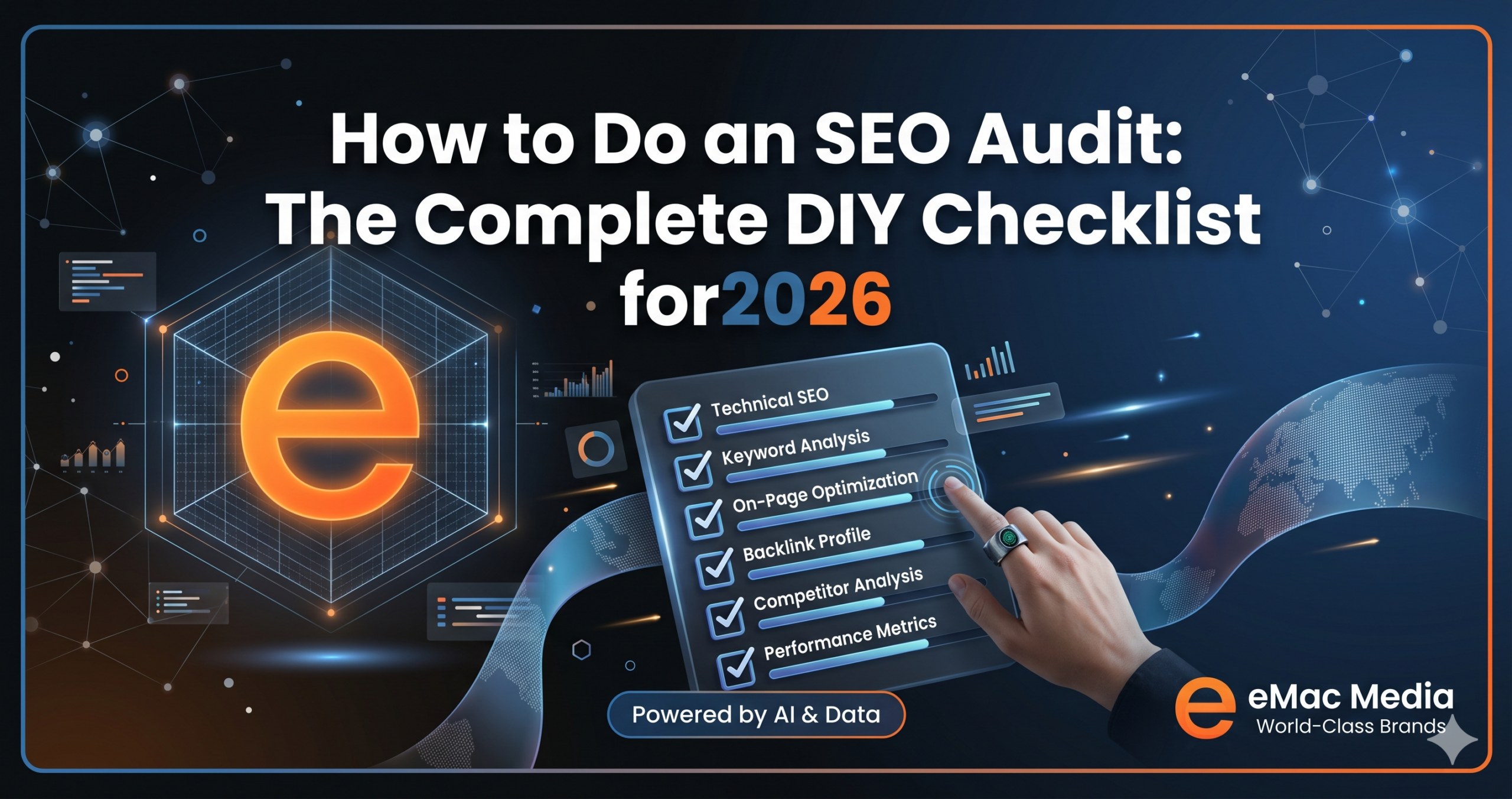
An SEO audit is a systematic review of your website's technical health, content quality, backlink profile, and search performance. In 2026, that scope has expanded to include AI visibility: whether your content gets cited in AI Overviews, ChatGPT, and other LLM-powered search interfaces. This guide walks you through every layer of a modern audit, from crawlability and Core Web Vitals to content pruning and answer engine optimization. Each section includes the specific checks to run, the tools to use, and the benchmarks that separate a healthy site from one bleeding traffic.
What Is an SEO Audit (and Why It Matters in 2026)
An SEO audit is a health check for your website's search visibility. You are looking at everything that affects whether Google (and now AI systems) can find your pages, understand your content, and choose to surface it to searchers. That includes server configurations, page speed, content quality, link equity, local listings, and a relatively new category: how retrievable your content is for large language models.
The reason audits matter more now than even two years ago comes down to one data point. Seer Interactive tracked 3,119 informational queries across 25.1 million impressions between June 2024 and September 2025, and found that organic click-through rates dropped 61% on queries where Google shows an AI Overview. Even queries without AI Overviews lost 41% of their CTR year over year. The traffic pool is shrinking, so the cost of technical debt, thin content, and broken link structures is higher than it has ever been. Every lost ranking now carries a bigger revenue impact than it did when clicks were more plentiful.
An audit gives you a prioritized list of what to fix. It replaces gut feeling with data. And if you run one quarterly, you catch problems before they compound into the kind of slow traffic bleed that takes months to recover from.
An SEO audit isn't a one-time project. It is a recurring diagnostic that should happen at least quarterly. In 2026, it needs to cover technical health, content quality, backlinks, local presence, and AI visibility. Skip any layer and you are leaving blind spots that competitors will exploit.
Technical SEO Audit Checklist
The technical layer is your foundation. If Google cannot crawl your pages, nothing else you do matters. This section covers the four areas of a technical audit: crawlability, speed, mobile readiness, and structured data.
Crawlability & Indexation
Start with Google Search Console. Open the Pages report and check how many of your pages are indexed versus excluded. Common exclusion reasons include "Crawled, currently not indexed," "Discovered, currently not indexed," and "Blocked by robots.txt." Each one points to a different problem.
Next, run a crawl with Screaming Frog or Sitebulb. You want to verify that your XML sitemap matches what Google is actually finding. Look for orphan pages that exist on the server but have no internal links pointing to them. Check for redirect chains longer than two hops. Flag any 404 errors, especially on pages that have inbound backlinks, because those represent lost link equity.
Pay attention to your robots.txt file. A single disallow rule in the wrong place can block entire sections of your site from being crawled. Cross-reference it with your sitemap: if a URL appears in the sitemap but is blocked by robots.txt, you have a conflict that needs resolving.
For larger sites with over 10,000 pages, crawl budget becomes a real concern. Check your server log files to see how frequently Googlebot visits your pages and whether it is spending time on low value URLs like filtered category pages or session ID parameters instead of your money pages.
Site Speed & Core Web Vitals
Google's Core Web Vitals are the speed metrics that actually affect rankings. In 2026, the three to watch are Largest Contentful Paint (LCP), which should load in under 2.5 seconds; Interaction to Next Paint (INP), which replaced First Input Delay and should come in under 200 milliseconds; and Cumulative Layout Shift (CLS), which should stay below 0.1.
Run your key pages through PageSpeed Insights and check both field data (real user metrics from Chrome) and lab data (simulated tests). Field data matters more for rankings because it reflects actual user experience. If your LCP is above 4 seconds, look at image optimization, server response times, and render-blocking JavaScript as the most common culprits.
Image files are usually the biggest offender. Convert to WebP or AVIF, set explicit width and height attributes to prevent CLS, and lazy load anything below the fold. For JavaScript heavy sites, defer non-critical scripts and consider code splitting to reduce your main thread blocking time.
Mobile Usability & HTTPS
Google has been on mobile-first indexing since 2023, meaning it primarily crawls and ranks the mobile version of your site. Check Mobile Usability in Search Console for any flagged issues through your web development team like text that is too small, clickable elements too close together, or content wider than the screen.
HTTPS is no longer a differentiator. The 2025 HTTP Archive Web Almanac reports that 97.5% of desktop requests now use HTTPS. If your site is still serving any pages over HTTP, fix that immediately. Mixed content warnings (HTTPS pages loading HTTP resources) also need cleaning up because they trigger browser security warnings and can break page functionality.
Structured Data & Schema Markup
Structured data has shifted from a nice-to-have to a competitive requirement, especially for AI search visibility. Backlinko's data shows 72.6% of first-page results use schema markup, yet only about 30% of websites overall implement it. That gap is your opportunity.
At minimum, implement Article schema on blog posts, LocalBusiness schema on your contact page, and Organization schema site-wide. If you sell products, add Product schema with pricing and availability. FAQ schema on pages with question-and-answer content can still generate rich results for certain query types.
Use Google's Rich Results Test to validate every schema type you deploy. Check for errors in Search Console's Enhancements reports. WebDataCommons data from 2024 found 51.25% of pages now contain structured data, and JSON-LD accounts for 70% of implementations. Stick with JSON-LD. It is the cleanest to maintain and the format Google prefers.
Need a Technical SEO Audit Done Right?
Our team has managed 291+ SEO campaigns across 200+ industries. We will find what is holding your site back and build a fix-it roadmap.
On-Page SEO Audit Checklist
On-page SEO covers everything a visitor (or crawler) sees on the page itself. Title tags, meta descriptions, headings, content structure, and internal links all live here.
Title Tags & Meta Descriptions
Title tags are still the single most visible ranking signal you control directly, and they are also the most commonly mishandled element on most sites. Ahrefs found that Google rewrites 33.4% of title tags, and it is 57% more likely to rewrite titles that exceed the pixel width limit. When Google rewrites your title, it uses the H1 tag about 51% of the time.
Keep title tags under 60 characters or below 600 pixels for desktop. Search Engine Land's analysis of 10,000 SERPs showed that titles closer to 46 characters had the fewest rewrites. Every page needs a unique title that includes the primary keyword naturally, not stuffed in awkwardly.
Meta descriptions do not directly affect rankings. Google has said this multiple times, and Ahrefs confirmed that 25.02% of top-ranking pages have no meta description at all. But they do affect click-through rates, which matter for traffic. Write them as 150-160 character pitches that give searchers a reason to click your result instead of the one above or below it.
Headers & Content Structure
Every page should have exactly one H1 tag that matches the topic. Use H2s for main sections and H3s for subsections. This hierarchy helps both search engines and AI systems parse your content. Crawl your site and flag any pages with missing H1s, duplicate H1s, or H1s that do not align with the title tag.
Content structure matters more now than it did before AI Overviews. AI systems retrieve passages, not whole pages. Content that reads as self-contained, factually dense chunks performs better than long narrative sections that bury the answer deep in the fourth paragraph. When you audit your pages, ask: can someone pull a useful answer from any single section of this page without needing the rest of it?
Internal Linking
Internal links distribute authority across your site and help Google discover pages. During your audit, identify pages with fewer than three internal links pointing to them. These are often your "orphan" pages, and they tend to underperform because neither users nor crawlers find them easily.
Check your anchor text distribution. If every internal link to your content marketing page uses identical anchor text, diversify it. Look for opportunities to link from high authority pages (those with the most backlinks) to pages you want to rank better. This passes link equity where it is needed most.
Content Audit Checklist
Content is usually where the biggest wins (and the biggest losses) live. An Ahrefs study of roughly 14 billion pages found that 96.55% receive zero traffic from Google. The odds are that a significant chunk of your own content falls into that bucket. The question is which pages to fix, which to consolidate, and which to remove entirely. A structured SEO audit makes that decision data-driven instead of subjective.
Content Decay & Refreshing
Content decay is the gradual loss of traffic to a page that once performed well. Animalz's benchmark study found that the median blog lost roughly 0.15% of its traffic per month from decay alone, even before AI Overviews showed up. Larger blogs between 100K and 1M monthly pageviews were hit hardest, losing close to 9% per month in some cases.
Pull up your Search Console performance data for the last 16 months. Filter by pages. Sort by clicks, descending. Now look for pages that had strong traffic 12 months ago but have dropped 30% or more. Those are your decay candidates.
Refreshing decayed content works. Animalz reports that updated articles typically recover 50% to 90% of lost traffic within three to six months. The refresh should include updated statistics, new internal links, current screenshots or examples, and improved content structure for passage-level retrieval. Don't just change the date and call it done. That trick stopped working years ago.
Content Pruning
Google assigns quality signals at the site level, not just the page level. Carrying hundreds of thin, outdated, or zero-traffic pages actively drags down the performance of your better content. This is not theoretical. An e-commerce site documented by Inflow increased strategic content revenue by 64% after deleting thousands of dead pages. A separate case study saw clicks and impressions jump 30% after noindexing 600,000 non-performing URLs.
Export all your pages from Search Console or your crawl tool. Flag any page that meets two or more of these criteria: zero clicks in the past six months, zero backlinks, thin content (under 300 words with no unique value), or duplicate intent with another page on your site. For each flagged page, decide: update, consolidate with a 301 redirect, or noindex.
Keyword Cannibalization
Cannibalization happens when two or more pages compete for the same keyword, splitting your ranking potential. Search Console makes this easy to spot. Go to the Performance report, filter by a specific query, and check the Pages tab. If multiple pages appear for the same query, they are cannibalizing each other.
The fix is almost always consolidation. Pick the stronger page, merge the best content from both, set up a 301 redirect from the weaker URL to the stronger one. Backlinko documented a case where consolidating two cannibalizing articles produced a 466% increase in clicks over eight weeks. That is not a rounding error. Cannibalization is one of the highest-ROI fixes you will find in any audit.
Off-Page & Backlink Audit Checklist
Your backlink profile is the hardest part of SEO to control, which is exactly why Google still weighs it heavily. Backlinko's study of 11.8 million SERPs showed that domain-level authority correlates more strongly with first-page rankings than page-level metrics. But the distribution is brutal: about 95% of all pages have zero backlinks, and only 0.08% carry more than 100.
Start with a full export of your backlinks from Ahrefs or Semrush. Sort by referring domains, not total links, because a hundred links from the same domain count far less than ten links from ten different domains.
Check for toxic or spammy links. Look for links from sites in unrelated industries, foreign-language link farms, or PBN-style sites with thin templated content. While Google says it mostly ignores bad links, a concentrated pattern of them can still trigger a manual action. If you find genuine spam patterns, use the disavow tool in Search Console as a last resort.
Review your anchor text distribution. A natural profile has a mix of branded anchors (your company name), naked URLs, generic terms ("click here," "learn more"), and keyword-rich anchors. If more than 30% of your anchors are exact-match keywords, that looks manipulated. Also check for broken backlinks: Ahrefs' link rot study found 66.5% of links built in the last nine years are already dead. Reclaim those by fixing the target URLs or setting up redirects.
Want to Strengthen Your Backlink Profile?
Our link building team earns placements from real editorial sites. No PBNs, no spam. Just links that move rankings.
Local SEO Audit Checklist
If your business serves a geographic area, local SEO is not optional. Whitespark's 2026 Local Search Ranking Factors report places Google Business Profile category, business name keywords, and proximity to the searcher as the top three local pack signals. None of those are new. What has changed is the weight of review recency.
Start your local audit with your Google Business Profile. Verify that your business name, address, phone number (NAP) is identical across your GBP, website, and every directory listing. Even small inconsistencies like "St." versus "Street" or a missing suite number can suppress local rankings. Check your primary category. It should be the most specific option that matches your business, not the broadest.
Reviews are not just social proof anymore. They are a ranking factor. Whitespark's Darren Shaw moved review recency into his personal top five ranking factors for 2025, noting that businesses that stop collecting new reviews see rankings decline within weeks. BrightLocal's 2024 survey found that 88% of consumers would choose a business that responds to all its reviews over one that doesn't respond. Set up a review response workflow if you don't have one. And yes, 58% of consumers in the same survey preferred AI-written responses over human ones, so using AI tools for review management is fair game.
One finding that surprised even local SEO specialists: Sterling Sky documented that rankings start dropping in the final hour before a business closes, and closed businesses rank materially lower than open ones for the same query. If extending your business hours is feasible, it may produce more local visibility than a dozen new citations.
Audit your local citations using a tool like Whitespark's Local Citation Finder or BrightLocal. Cross-check your NAP on at least the top 20 directories for your industry. Fix any inconsistencies, remove duplicate listings, and fill out incomplete profiles. BrightLocal reports that 41% of consumers check three or more platforms before choosing a local business, so consistency across every listing matters.
AI Visibility & AEO Audit Checklist
This is the layer most businesses are still ignoring, and it is the one that will separate winners from everyone else over the next 18 months. Ahrefs found that AI Overviews reduce clicks to the top organic result by 58%. That traffic doesn't disappear. It gets absorbed by Google's own AI answer. The question is whether your content gets cited inside that answer or not.
SeoClarity's analysis of 432,000 keywords showed that 97% of AI Overviews cite at least one source from the top 20 organic results, with an average of five URLs per overview. Brands cited in AI Overviews earn 35% higher organic CTRs and 91% higher paid CTRs than uncited peers, according to Seer Interactive. Getting cited is the new ranking.
Here is what to audit for AI visibility:
Check your crawlability for AI bots. Review your robots.txt to see whether you are blocking GPTBot, ClaudeBot, PerplexityBot, or other AI crawlers. Blocking them means your content cannot be used for training or retrieval. That is a business decision, but you should make it consciously, not accidentally.
Evaluate content for passage-level retrieval. AI systems pull specific chunks, not entire articles. Each section of your content should contain a self-contained, factually complete answer to a specific question. Vague setup paragraphs that require reading three pages of context before reaching the point will not get cited.
Add entity-level structured data. Schema markup helps AI systems identify what your page is about and who is behind the information. Organization, Person, and Article schemas signal authoritativeness. SameAs links to your social profiles and industry directories reinforce entity recognition.
Track your AI visibility. Monitor whether your brand appears in responses from ChatGPT, Perplexity, Gemini, and Google's AI Overviews. Tools like Ahrefs and Semrush have added AI monitoring features, and specialized platforms for tracking citation frequency are emerging. If you are not measuring this, you have no idea whether your content optimization is working. If you want help setting this up, book a free consultation and we will walk you through it.
SEO Audit Tools You Need
You do not need to buy every tool on the market. Here is the stack that covers each audit layer, organized by whether you will pay for it or not.
| Tool | What It Covers | Cost |
|---|---|---|
| Google Search Console | Indexing, performance, Core Web Vitals, manual actions | Free |
| Google PageSpeed Insights | Core Web Vitals, performance diagnostics | Free |
| Screaming Frog SEO Spider | Technical crawling, broken links, redirects, metadata | Free (500 URLs) / Paid |
| Ahrefs | Backlinks, keyword research, competitor analysis, site audit | Paid |
| Semrush | Keyword tracking, site audit, content optimization, PPC | Paid |
| Google Rich Results Test | Schema markup validation | Free |
| Whitespark / BrightLocal | Local citations, GBP audit, review monitoring | Paid |
Ahrefs holds roughly 14.83% market share in the SEO tools category according to 6sense, with over 54,000 companies using it. Semrush has about 24,800 paying customers and crossed $105 million in quarterly revenue in Q1 2025. Both are investing heavily in AI search tracking features. For most businesses, you need one of these two paid platforms plus Google's free tools and a crawler. Trying to run an audit with Search Console alone will leave your backlink and competitive analysis incomplete.
How Often Should You Run an SEO Audit
The short answer: quarterly for a full audit, monthly for technical spot checks.
A full audit covers everything in this guide: technical, on-page, content, backlinks, local, and AI visibility. Set it on a calendar. Q1, Q2, Q3, Q4. Each one should produce a prioritized list of fixes with estimated impact, and that list should feed directly into your content and SEO roadmap for the next 90 days.
Monthly technical checks are lighter. Run a Screaming Frog crawl, check Search Console for new indexing errors, review Core Web Vitals for any regressions, and scan your backlink profile for sudden spikes (which often indicate spam). These checks take an hour or two and prevent small issues from becoming quarterly emergencies.
After any major site change, run an audit immediately. CMS migrations, redesigns, domain changes, large-scale content additions or deletions, eCommerce platform switches, and URL structure changes all introduce risk. The audit after a migration is arguably the most important one you will ever run because broken redirects, missing canonical tags, and orphaned pages from the old site can tank traffic within days.
Frequently Asked Questions
References & Sources
- 1AIO Impact on Google CTR: September 2025 Update — Seer Interactive
- 2Google AI Overviews Drive 61% Drop in Organic CTR — Search Engine Land
- 3AI Overviews Reduce Clicks by 58% — Ahrefs
- 496.55% of Content Gets No Traffic From Google — Ahrefs
- 5We Analyzed 11.8 Million Google Search Results — Backlinko
- 6124 SEO Statistics for 2024 — Ahrefs
- 766.5% of Links to Sites in the Last 9 Years Are Dead — Ahrefs
- 8Content Marketing Benchmark Report — Animalz
- 9Keyword Cannibalization: Why Avoid It and How to Fix It — Backlinko
- 10How This Brand Removed 600K Pages and Traffic Went Up — SEOCopilot
- 11Security: 2025 Web Almanac — HTTP Archive
- 12Structured Data In 2024: Key Patterns Reveal The Future — Search Engine Journal
- 13Google Changes More Than 61% Of Title Tags — Search Engine Journal
- 14What Should the Title Tag Length Be in 2025? — Search Engine Land
- 157 Local Search Ranking Factors — Whitespark
- 16Review Recency is the Most Underrated Local Ranking Factor — Whitespark
- 17Local Consumer Review Survey 2024 — BrightLocal
- 18Impact of Google's AI Overviews: SEO Research Study — seoClarity
- 19AI Search Content Optimization Checklist — Aleyda Solis
- 20Schema Markup: Statistics, Facts, & Things to Know — Sixth City Marketing


Stop Guessing. Start Auditing.
Not sure where your site stands? Our team runs comprehensive SEO audits that cover every layer in this guide, then builds you a prioritized 90-day action plan.
Get Your Free Strategy Proposal
No comment yet, add your voice below!